打字寫作: on typing and composition

Happy holidays!  We took a few days of my DD’s Christmas break to do some Chinese lessons.  To get ready for next summer’s lessons on composition, I took the opportunity to “teach” “Charlotte”, my 12 year old, how to type pinyin (like I know how~), by giving her print-outs and links to YouTube videos on the topic.  After spending a couple of hours on it between yesterday and today, she typed the following needing only some corrections (wrong choice of character with the same sound):

“從前有一個小女孩名叫凱莉,她非常可愛。

她有頭烏黑的短髮,紅紅的雙頰,和又亮又大的綠眼睛。

她是一個很乖的小女孩,也是一個心地善良的孩子。

有一年冬天,凱莉的媽媽去世了,讓她和她爸爸很難過。

在她媽媽的葬禮,凱莉跟自己說,人要懂的放下。  她發誓,要成為一個堅強的人

轉眼間,十三年過去了。  凱莉二十歲了。

在那時候,十七到十九歲的少女都開始相親和結婚了,可是凱莉還沒。

她為了照顧她的爸爸,所以沒有去想那件事。

有一天,凱莉的爸爸問她,“凱莉,妳為什麼不去結婚?  我可以照顧我自己。”

凱莉翻了一下白眼,她對她爸爸說……..”


I am so proud of my DD!  This is the first time she writes anything in Chinese, as in compose rather than practicing characters, in ~ 4 years, as I had mostly concentrated on improving their reading proficiency previously.  I think this comes from all the Chinese readings she has done.  I was counting on her relatively high reading proficiency and breadth of reading to show her what Chinese writing should sound and read like.   I am much encouraged by Charlotte’s first piece of writing at this point.

Of course, “Georgia”, who is 9 and wants to do everything her elder sister does, is now very motivated to learn how to type Chinese with pinyin herself!

Addendum:  Here is what she typed the following day in about an hour:

凱莉翻了一下白眼,對她爸爸說,“您一個人在麵包店裡做不了多少,需要幫忙。”凱莉的爸爸想了一下,又說,“可是妳結婚後還是可以回來幫我啊。”  從凱莉的爸爸坐下來的位子,就能聽到在廚房的凱莉嘆氣。

“嫁人有那麽慘嗎?  又不是說沒人要娶妳。” 她爸爸好奇的問。

“您不是說不會逼我結婚嗎?  怎麼現在突然要我嫁人啊?” 凱莉不耐煩的回答。

“我只是問一問而已。” 她爸爸自言自語的說,然後搧一搧手裡的紙扇。

突然,有兩位客人走進麵包店。  凱莉快速的上前招待。  幾分鐘後,凱莉拿著一封信走回店舖後。  凱莉的爸爸問,“誰寄的信?“

”好像是從皇宮寄來的。“凱莉說。  她的爸爸馬上起身而從凱莉的手裡搶走信封。

相聲 & other videos

As part of our CLE (Chinese language ecosystem), my girls watch quite a few entertaining YouTube videos, many of which have cultural references, either historical or current.

The following is a stand-up routine from Taiwan back in the late 1980s, with references to historical and cultural events in Taiwan and mainland China from ~ 1940s to 1980s.  My girls and I watched this a couple of years ago and we are re-watching it tonight.  It’s really funny.  They should learn something different every time they watch it.

Along with explanation, educational programs such as China: A Century of Revolution, and movies such as 末代皇帝 The Last Emperor and 霸王別姬 Farewell To My Concubine, I hope to give my daughters some idea of the events of those era, some of which were intimately tied to how they came to this world in the first place.


Below, I also list a few of the YouTube videos, movies, and TV series we had enjoyed over the past 5 years.  These really help them solidify their interest in the Chinese language.

Avalon of Idaho:


Jesus of Spain:


老外看中國


The PG version of You Are The Apple of My Eye (那些年,我們一起追的女孩).  The link below is a PG-13 version instead.


Secret (不能說的秘密)


重返二十

致我们终将逝去的青春

神雕俠侶 cartoon!   The first kungfu cartoon series they watched about 5 years ago.  This is the first time I find it on YouTube!


倚天屠龍記


笑傲江湖  


Of course, I try not to miss out on American culture as well.  Here is one excellent series of the Civil War era featuring Patrick Swayze: North and South.  It gets agonizing to watch toward the end since more and more misery pile on.  My wife and I could not finish watching it a decade ago and neither can my elder daughter and I a year to two ago.


Singapore vs. PRC primary school Chinese reading level

I have just read a number of discussions on Singapore’s education system and the Chinese curriculum there.  Singapore manages to pack a lot of learning for their students and has a world class educational system, as far as standardized testing is concerned.  As best as I gather, Chinese is taught as a stand-alone class, at most one period a day during school, as the rest of the school instruction are conducted in English.

In any case, I looked up some reading samples from Singapore.  Here is Singapore website published by the Ministry of Education in Singapore.  Click on a 高級華語 textbooks for the first semester of sixth grade.  The passages look very reasonable to me, for 6 years of daily one-period instructions with established CLE in the country.  I think my 9 year old should be able to read these in traditional characters or very close to reading them proficiently.

I then looked up China’s textbooks for first semester of sixth grade.  Here is one link what I found : 6th grade textbook.

It appears, to me at least, that China’s Chinese reading level is higher than that of Singapore’s.  That’s not surprising given, I presume, almost all classes are conducted in Mandarin Chinese in China.

So, once again, more exposure / learning = higher level.  Simple as that.

On multilingual kids in Taiwan


It is very doable to be raised trilingual in Taiwan in Mandarin Chinese (community language), English (the lingua franca of the world), and another mother tongue of one of the parent, if one parent is a fluent Chinese/English speaker and another parent is fluent English/the other mother tongue speaker, and the parents communicate in English.  These kids are likely biracial.  My brother’s family is like that and may even know this young lady.  So, my nephews are trilingual in Mandarin Chinese (and reads 金庸 novels too), English, and Danish.  They homeschooled a couple of years also.  They likely know a number of families whose kids do something similar, including another Taiwanese-Polish family.

I suspect many of these kids have some international experiences, like growing up abroad till around 6 and/or spend summer breaks abroad in the country of the third language (other than English and Chinese).  It helps when there are many international expats living in Taiwan whose children are native English speakers.  It probably helps when the third mother tongue is held in high esteem by the community.  My suspicion is many of these kids enjoyed some type of alternative schooling at some point, rather than attend 12 yeas of regular compulsory education through the Ministry of Education.  There are established homeschool groups that kids can join.

Learning multiple languages while growing up is not difficult, as long as there is a ready community/resources that supports such development and measure proficiency according to multilingual standards.  Many populace around the world do this all the time.  What is difficult in the US for kids to learn English and a category V language is the lack of such ready community/resources, with English as still the lingua franca of the world and the amount of time needed to be develop higher level competency in the category V language early on.  The difficult task for US families is therefore to “artificially” create such community/resources, or the CLE (Chinese language ecosystem) that I talk about.  Obviously, if parents enroll the children in traditional schooling and want the children to “excel” in the various academic and nonacademic activities that other mostly monolingual kids participate in, that put further time constraint in the picture.

下ㄧ代 (Next generation )

An older adult immigrant parent once commented something along this line, “Why spend so much effort teaching the children Chinese?  Their children won’t be able to speak Chinese anyway.”  What she meant was that second generation heritage children mostly achieve low Chinese proficiency level; so, their own children (3rd generation) practically have little chance of learning much Chinese at all.  The “line” will be broken anyways.

Well, that was NOT my plan from the beginning.  我自己是第ㄧ代半.  I am a 1.5 generation immigrant, having emigrated at the age of 11, and my daughters are 2.5 generations.   I want something that is reproducible for the next generation.  I would say that my overall Chinese proficiency is about ILR level 4-4.5.  My listening should be close to 5, my general speaking 4.5, my reading 4-4.5, my writing (at least composition) – around 3.5 (I hope!).  I wanted my children to achieve level 3.5-4 in overall proficiency by the end high school.  If they continue to learn and read Chinese in college and their 20s, they should be able to improve further to solid 4-4.5 by the time they are parents.  When they raise their own children in Chinese and English, as they will be consolidating their foundation further.  My wife and I will even consider moving back to Taiwan for a period of time to hopefully care for our grandchildren (if any) for a few months a year for the first 6 years of their life, to help provide them a strong foundation in the Chinese language.  So, hopefully through similar path and with further technological advances, my grandchildren will be able to achieve 3.5 by the end of high school.

這樣,至少有可以承傳給她們的下ㄧ代。But that’s just me.

Characters recognition vs. reading proficiency

A parent’s question:  How many characters does one need to be able to read a children’s chapter book fluently?  An wuxia novel (e.g. Jin Yong)?  A newspaper?

My take on it:  There are characters, and then there are words/vocabularies and idioms, which are often combination of characters. On top of that is reading proficiency/fluency (with good comprehension of course), which takes practice, even if one recognizes all the characters and words.  In general, knowledge of 1,600 characters cover about 95% of the characters in regular mass media, at least for traditional characters, and that is generally considered the minimum to be considered “literate”.  Of course, one can know what certain characters/words mean when one reads them, but without knowing how to pronounce it. There are different levels of children’s books, chapter books included of course.  If I have to make a guesstimate, I would say it takes familiarity of somewhere around 600-1,000 characters to start reading chapter books, though reading proficiency / fluency takes practice over time.  A child who knows 1,000 characters and read a book at 500 characters a minutes with good comprehension has much higher overall proficiency than a child who recognizes 1,500 characters and reads the same book at 100 characters a minute.  Similarly, reading proficiently more advanced media such as Jin-Yong kungfu novels and newspaper written for regular adults (not abridged version for language learners) requires much more than character recognition.  There are words, phrases, idioms, background knowledge/concepts, and relevant cultural knowledge involved.  But, if you really want to have a number to work with, I would say knowledge of 2,000 characters is the minimum. In general, I think parents shouldn’t dwell on the number of characters the child knows but whether the child can read proficiently.  Reading proficiency is so much more than character recognition.

Narnia

“Georgia” finished reading “Narnia: The Lion, The Witch, and the Wardrobe” today.  The Chinese edition consists of 17 chapters, totaling 193 pages with scattered drawings.  She spent ~15 minutes a day reading 2 chapters for most days of this past 9 days.  I have to say that she prefers reading just one chapter a day; but I asked that she reads two chapters a day.    One day, I did ask her to read three chapters but in two blocks;  that was too much for her really.

In any case, she gets the gist of the story but some of the details she missed.  For example, I asked her what happened between the witch and Aslan toward the end and she did not know that Aslan was killed but then was resurrected.  But then again, that may be asking a little too much of a 9 year old just starting to read such novels in Chinese.  I am sure that as her Chinese improves and she gets more mature over time, such details will become more evident.

In any case, she is now watching the movie version now, in English.  Gosh, I thought I bought the Chinese edition dubbed with Mandarin.  It turned out to be dubbed in Cantonese!  That won’t work for us.  Hence, they are watching it in English now.  She did watch this movie several years ago but she does not recall any of it since she was so young then.


Writing

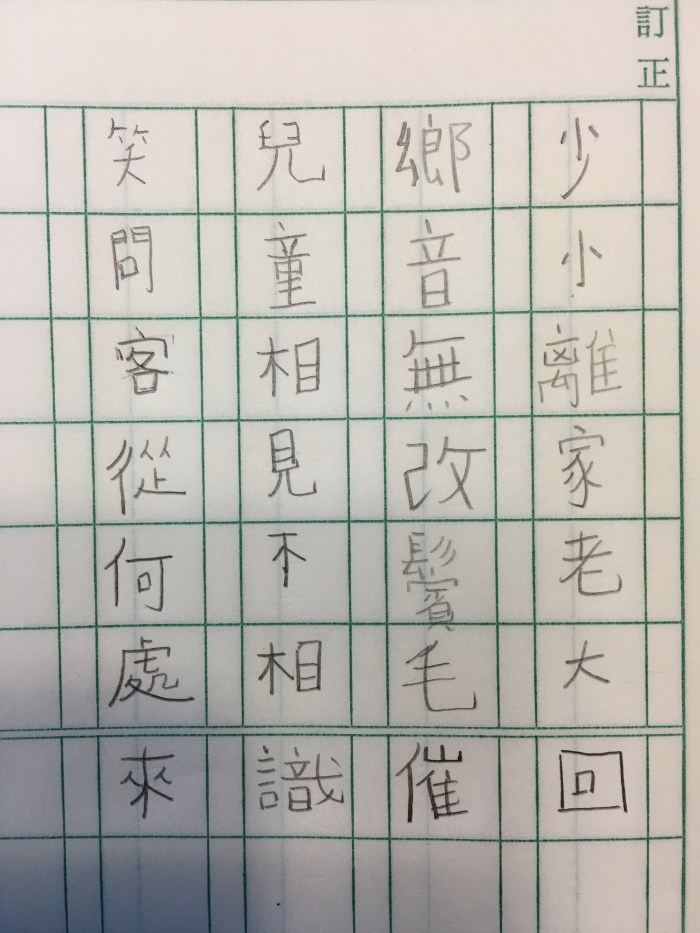
Since the girls have both achieved basic reading proficiency for their age ( ILR level 3, I would say), I am adding additional writing practice.  They had memorize a few Chinese poems before; so I printed out writing worksheet of one whole poem with the stroke sequence included.  I handed them the worksheet and told them that I will “test” their writing of the poem from memorization in one week.  Their continuing enjoyment of certain privilege will depend on how well they do.  They are responsible themselves on how much practice they need to achieve that.  In a few days, 9 year old “Georgia” has got it.

因閱讀已經達到基本程度,可以開始多寫一點。以下是小女兒練習背寫的「回鄉偶書」。我印出自做,整首詩有筆順的單字練習紙,交給女兒們,跟他們說,ㄧ個禮拜後考背寫,練習多少自己要負責,不會的話……就不xxxxxx.  她們以前都背過這首詩,小女兒幾天就會寫了。


image


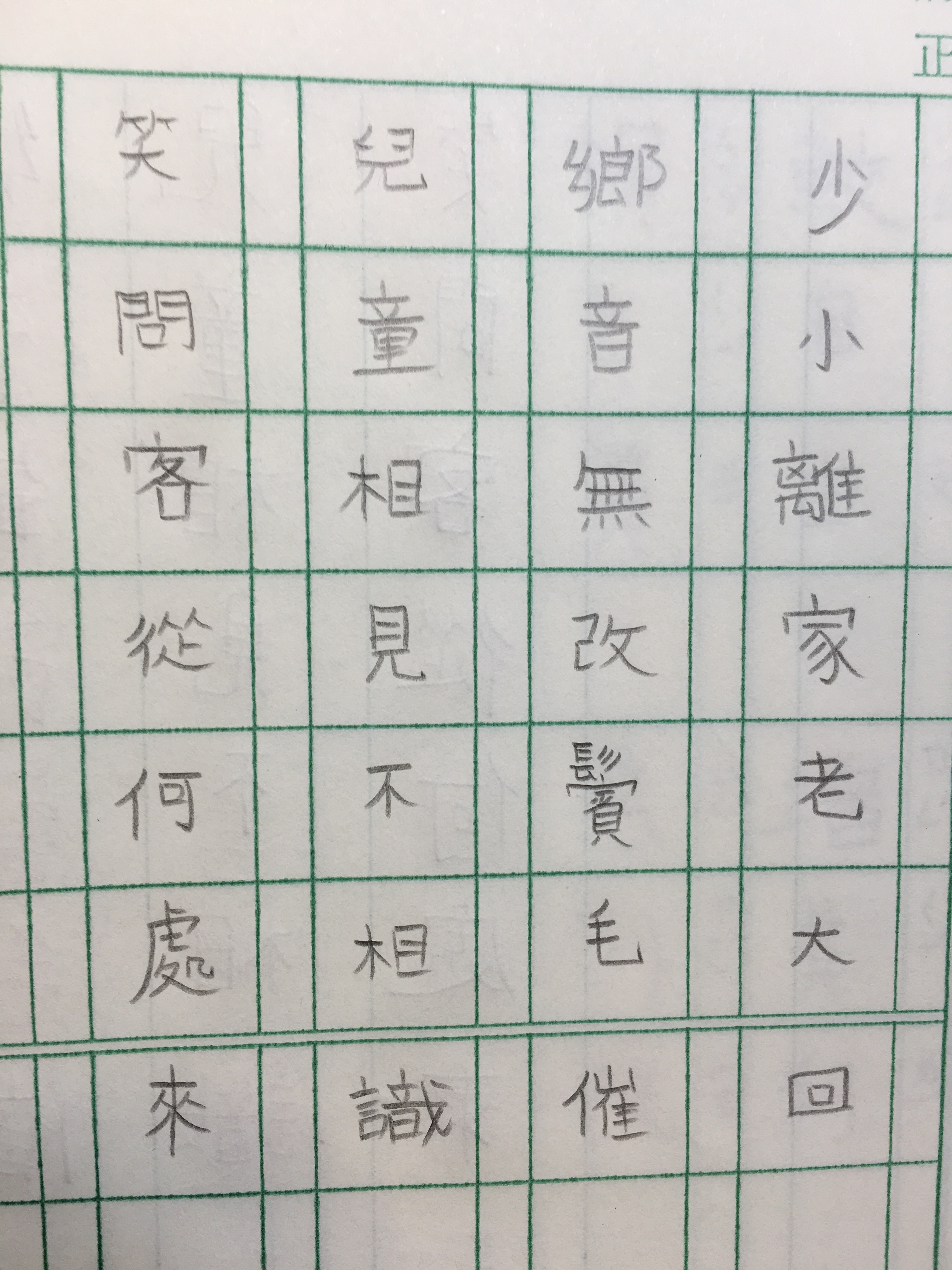
Not to be outdone, 12 year old “Charlotte” practiced and wrote the following the next day:

image

Q&A

Q: 你女兒的中文程度這麼好,那他們的英文程度呢?他們的中英文閱讀時間你是怎麼安排呢?謝謝

A: 大女兒ㄧ開始以中文為重,目標為七八歲前中文比英文強,才能流利都跟妹妹說中文。三年級後半開始加強英文(那時英文蠻爛的),花~三年時間把英文拉回同儕母語級,現在很喜歡看英文小說和寫作。

因有姊姊的中文教材及幫助,妹妹比姊姊同年紀時有較完整的中文環境。除中文寫作以外,小女兒中英文同等發展,中間差距較少。小女兒天賦不錯,跳一年念,英文閱讀寫作該跟同年學生差不多,但比大她一歲也資優的同年同學還差,但該會每年縮小差距。

女兒們吃早晚餐都會自己拿中文漫畫,小說來看,因文字不是障礙。我也會每星期撥些時間(~兩三個小時)給她們看中文故事書或小說。

在美國要小孩中英文都要夠強,兩個都需要。不是說就是要去上習班,而是需要有心及有學問人士來帶小孩克服些難關。可在7-8歲前以中文為重點,之後再英文。在家,女兒們的中英文由我負責,除指導以外,也替她們找中文家教(畢竟我只念到小五)。

依我的觀察,大學後才移民到美國的家長的英文會比較吃虧,因此他們可能比較不敢讓小孩慢點學好英文,所以小孩的中文學習可能會受影響,除非家長本身是在高中小學校就職,比較清楚美國的教育系統及教學。而本來是小留學生的父母(十二歲左右來的),因中英文都不錯,而且自己走過在美國學英文的路,比較不會擔心小孩英文不會學好,也比較能在適當的時間小孩的英文,所以可能比較敢放手讓小孩小時候多多學中文。


Q:請問你以前女兒小的時候,有要求她們寫字嗎? 還是一開始就花時間在認字閱讀呢?謝謝

A:基本寫字筆順從小都有訓練,課文單字也都有練習,現在要以背寫唐詩為主。大女兒明年暑假要以打字練習作文。

對在家有聽中文的華裔學生而言,我認為ㄧ開始同時注重中文閱讀及書寫是欠佳的。在三四年級時,能以閱讀中文漫畫或較有意思的故事書為娛樂是最重要的ㄧ節,不然就幾乎全被英文文學及多媒體拉了過去,大幅度的減低了對小孩而言學中文的實質意義(no relevancy)及興趣。因小孩事情也多,時間有限,我建議首先以認字閱讀及朗讀為主。到小說會念時,再來加強寫作(打的就可以了)。當閱讀朗讀多了,寫作自然會較好。可惜,在正規體系內為主的學習,都注重以寫功課或筆考來衡量成績及進度,影響大局。