Here is a rough concept version of what is feasible. Do you have any suggestions? 拋磚引玉。請多多指教。
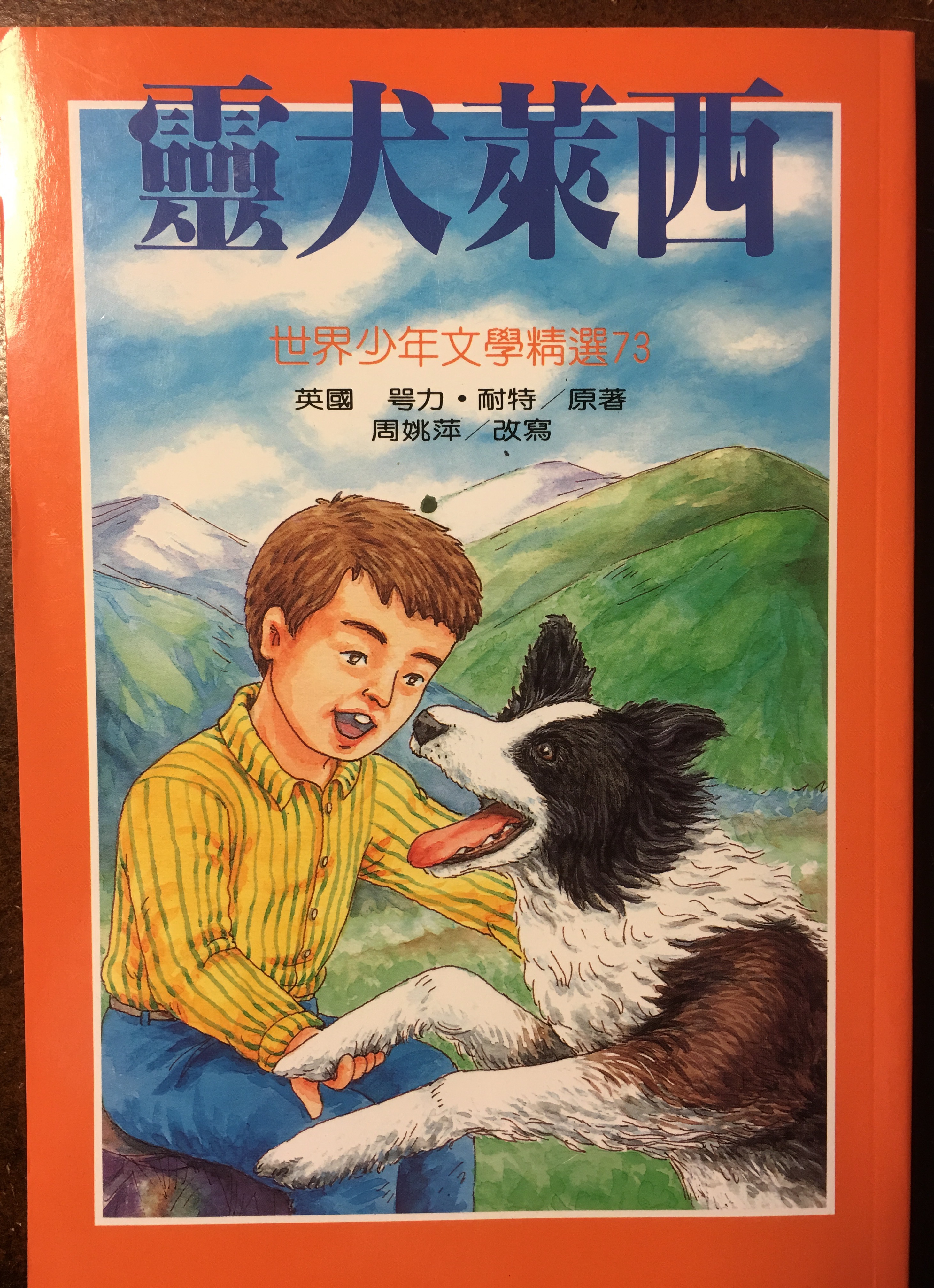

Here is a sample test on Lassie Come Home: Lassie Come Home sample test.
Here is a downloadable version with 注音: 靈犬萊西閱讀測驗普及注音版.
Here is a rough concept version of what is feasible. Do you have any suggestions? 拋磚引玉。請多多指教。
Here is a sample test on Lassie Come Home: Lassie Come Home sample test.
Here is a downloadable version with 注音: 靈犬萊西閱讀測驗普及注音版.
Thanks to Guavarama, who organized group book purchase from Taiwan, we recently received the book collection from 東方出版社‘s 世界少年文學精選. This is a collection of 119 classic books of the western world, rewritten in traditional Chinese specifically for children (probably abridged in some way), with zhuyin assistance, with renowned titles such as Romeo and Juliet, Secret Garden, Moby Dick, Lassie Come-Home, The Adventures of Tom Sawyer, The Three Musketeers, and the likes. This series has been around for 20+ years and is intended for 8-9 year old children in Taiwan.
My now 10 year old younger dd, “Georgia” has read the first three and is now almost finished reading Lassie. It takes her about 2-3 hours to read each book and will probably take me 1.5 to 2 hours to do the same. It would be great if I have the time to read these books myself so that I can ask her appropriate questions to check her comprehension. Yes, I can read the Chinese excerpts from Wikipedia or similar website but it will still take me some time to.
It dawns upon me that it would be great if there is Accelerated Reader type of questions for these books. There are pros and cons to these books.
Pros:
Cons:
With these in mind, I decide to explore commissioning Jessica, a free lance writer in Taiwan whom I had worked with on other projects, to create authentic Chinese questions banks (not translated from unabridged English edition) for some of these books. At this stage, these questions would simply assess whether the reader has basic understanding of the plot.
At this point, Jessica borrowed the books from the public library and came up with three sample questions for “Lassie Come-Home” or “名犬萊西”. To come up with 15 questions for this book, she quoted me ~ US$50. She wrote three sample questions for met at his point.
靈犬萊西
1. 書中的主角萊西是屬於哪一種狗?
a) 狼犬
b) 牧羊犬
c) 貴賓狗
d) 牛頭犬
*Ans: page 13
2. 書中的老公爵等了多久採買到了萊西?
a) ㄧ年又三個月
b) 兩年
c) 三年
d) 三年半
*Ans: page 29
3. 萊西第二次逃回的家時,是誰把他帶回老公爵的家?
a) 漢斯
b) 山姆
c) 喬
d) 山姆和喬
Ans: page 48
I think it would be great if the community of traditional Chinese learners and their families can help fund such a project. I think weekend Chinese schools would be very interested in such a project as well. I can then look into putting these questions online. With a proper FREE website, students to create their own account and the computer will score the questions for them. We can look into creating similarly authentic question banks for abridged version of Chinese classics and easier translated works such as the Magic Tree House series. These won’t be outdated either. Who knows, we can also put up questions for 金庸‘s kunfu novels, which my elder dd, almost 13, is reading. There are some online questions already, such as these two links: A & B.
Do you think this is a worthy project to fund?
Addendum: I think this can be very helpful for weekend Chinese school students. One way to minimize cost is to get interested native level immigrant parents and teachers (who are likely also parents) nearby to help out with question generation. A number of parents in my FB group, many in California, an I have the same set of books. We can approach nearby weekend Chinese schools to see if there are parents and teachers who would be interested in each borrowing a few books from us and then generating 15 questions for each book. Divide and conquer. The whole set can be done in no time. Interested Chinese schools can then just buy a set or two of these books for the school library and students can check the books out.
Achieving Chinese-English bilingualism and biliteracy for a child is no easy task. Well, let me rephrase that: achieving Chinese-English bilingualism and biliteracy for a child is a very difficult task. I am reminded that just about every single day.
As I have written in previous posts, in my opinion, one just about have to let English slide in the beginning. To achieve Chinese ILR level reading level ~ 4 by early teens, I estimates that roughly 2/3 of the Chinese instructions and learning have to be front loaded and compressed into pre-middle school years. Then, around the time when Chinese reading proficiency is at least minimally proficient (at least able to read comics for leisure), start catching up in English, with the goal of reaching age/intelligence matched level sometimes in middle school. If the child can read Harry Potter or the likes in English before they can read interesting books in Chinese, that can be recipe for trouble, in terms of Chinese literacy, as the child can quickly loose interest in Chinese reading.
On the flip side, the lack of English proficiency can affect other subjects, which may put tremendous stress on the children and the parents, particularly when the children attends all-English school, like mine. As the children were still young at that age, I was not overly concerned about the other subjects, though math word problems, which have a strong language component, can present quite a challenge. It had been my hope that with catching up in English and adequate math practice, the child will outgrow that phase.
As mentioned in prior posts, the English proficiency of my elder daughter “Charlotte” was terrible when she was attending third grade in the small private school she attended (more “limited” public school options in more rural NC). Though it was so by my design, I just about couldn’t take it then, particularly when I supervised her homework time. And her Chinese was still not strong enough. So, I pulled both of my daughters out mid-school year and have them homeschooled for about 20 months. Charlotte’s Chinese and English both improved much through homeschooling. She then returned to another private school starting 5th grade.
Like most students in NC, Charlotte is required to take a national standardized achievement test every year, which is TerraNova for her current school. Her language composite score was 88 percentile (5th grade), 95 percentile (6th grade), and 98 percentile (7th grade) over the past three years. I did work with her some more on her English up till ~ first half of her 6th grade, after which I determined that “she’s got it!” and let her fly solo. In short, she has caught up during middle school, as we had hoped for. We are pleased with her progress and hope that she keeps up her good work.
As for my younger “Georgia”, she have had the dual challenges of learning Chinese well and skipping a grade. I think she would have qualified to be enrolled in HAG public school program if we had one. Since we live in a small and relatively rural county, we don’t have one such program; so, I resorted to letting her skip a grade when she returned to private school. Her English has improved quite a bit over the past two and half years but remains a challenge in 5th grade, which is starting to affect her other subjects more. As she will be starting middle school in the fall, we will be working on her English over the summer, upon her return from 6 weeks of stay in Taiwan, where she will attend a month of public school in the 4th grade. It will be back to homeschool mode for much of the rest of the summer. I think this will be her last summer of attending school in Taiwan for the month of June. Next summer, I think she will just spend a couple of weeks in Taiwan having fun, instead of attending a month of 5th grade. The other time, we will devote to catching up in English to the level of her grade peers, who are at times two years older than she is. We hope that she doesn’t have too much on her plate.
All of these just reminds me of Mathew 7:13: “Enter through the narrow gate. For wide is the gate and broad is the road that leads to destruction, and many enter through it. But small is the gate and narrow the road that leads to life, and only a few find it.”
A few recent posts and comments got me thinking once again about the limitation of the typical Chinese pedagogy in anglophone society, whether it be weekend Chinese school, home instruction, or immersion school. I, of course, always have to refer to Foreign Service Institutes’s list of the approximate time one needs to learn a specific language as an English speaker to reach ILR level 3 in speaking and reading. Basically, Mandarin Chinese takes about 4 times as long to learn as category 1 languages, which include Spanish, French, and Italian.
This, along with other observations of mine, generates a number of implications for children born/raised in anglophone society:
But, it is certainly not the end of the world. There are a number of ways to reach higher Chinese proficiency in college and beyond, for those who elect to do so. Not to mention other skills one hopefully acquire by not devoting such time and effort in Chinese. For me, the question that I pose to other parents is pretty simple: “Do you prefer that your child have good Chinese proficiency vs. good piano or violin proficiency (or other skill sets you may prefer) by 20-30 years old?” There is certainly no right answer, just your answer.
Almost 10 years old “Georgia” is making good progress reading books from “世界少年文學精選“ (World Literature, well, mainly western classic books) series. She starts by reading books whose content she is familiar with, such as Romeo and Juliet, Secret Garden, and now Peter Pan.
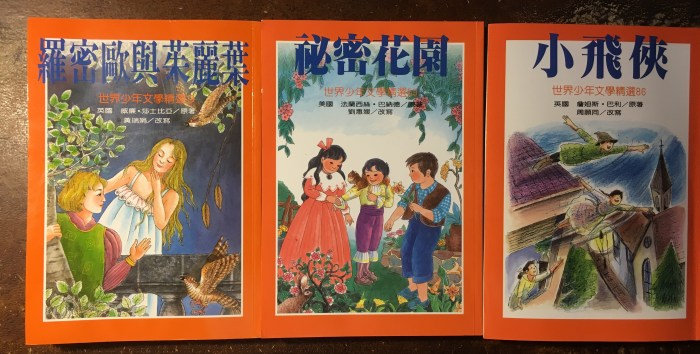
That’s just dandy with me, as this is part of the Scaffold Reading Experience or SRE. I ask her to read at least 50 pages a day, which should work out to be at least ~ 10,000 to 11,000 characters. Over the past 10 days or so since the books arrived, she has read about 600 pages or ~ 130,000 characters; so, we are on target.
With her willingness to read these books, I think she will be able to read at least 3,000,000 characters by this time next year. Yes, that’s 3 million characters! By this time next year, I am certain her reading speed will pick up quite a bit and her proficiency of characters and expressions of this reading level will be quite good.
Once again, thanks to Ms. Lin of Guavarama who organized the group book purchase from Taiwan, we are set for the next year to two!
Now that the girls have decent Chinese and have watched a number of Chinese themed movies or TV shows, we are returning to reading aloud abridged version of classic Chinese. I think classic Chinese stories use more Chinese word phrases, idioms, and expressions than translated books. 中國傳統故事比翻譯故事用較多的詞語,用語,和成語。
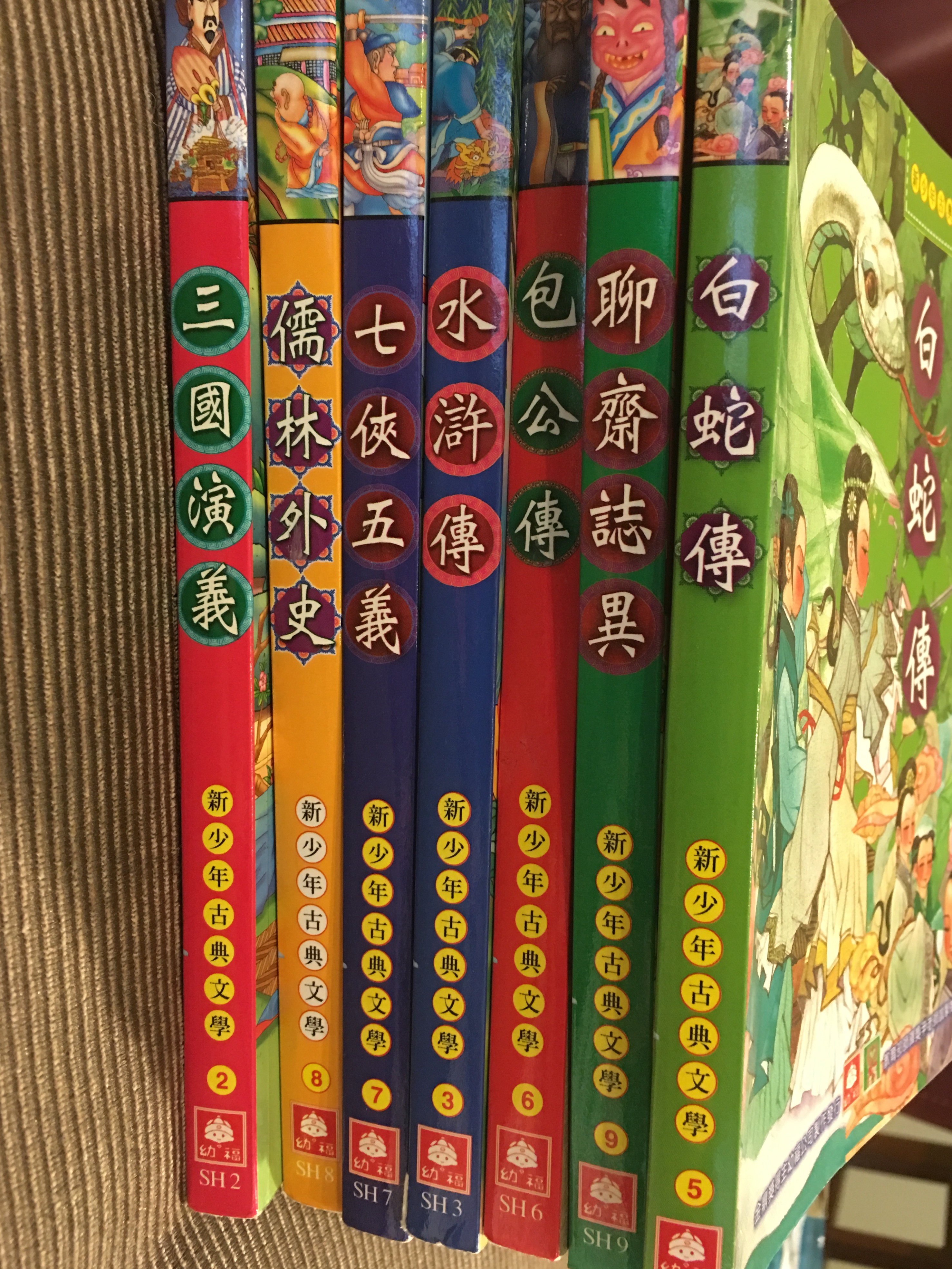

Here, 9 year old “Georgia” is reading 白蛇傳 (Legend of the White Snake) with the tutor.

Thanks to fellow parent Ms. Lin of Guavarama who organized group book purchase, we got our shipment of World Literature selections from Eastern Publishing in Taiwan (東方出版社 – 世界少年文學精選) this last couple of days, after waiting for about two months. There are supposed to be 119 books but three were missing from the shipment.


These books are meant for 8-9 years old in Taiwan, particularly given they have zhuyin 注音. These books are longer and more difficult than the last dozen books of the Chinese edition of Magic Tree House. Book #4o of the Magic Tree House probably had ~ 18,000 characters, which my now almost 10 years old “Georgia” read at ~ 800 to 1,000 characters a minute a few months ago. The first book that Georgia picks out to read from this newly arrived series is Romeo and Juliet. I estimates that there are ~ 65,000 characters in this book, so more than 3 times as many characters. For translated literary work, the thing that I hate the most are the translated names! That really messed my “Charlotte” up, while reading the Chinese edition of Twilight and the Selection series.


Georgia is familiar with the English version of the story of Romeo and Juliet. In any case, she is reading Romeo and Juliet at ~ 2 pages a minutes, or ~ 450 characters a minute by rough estimates. So, I think she can read the book in about 2.5 hours. That’s half of the speed that she was able to read Magic Tree House, for good reasons. The content is more advanced and there are many more characters involved, with their awful translated names! Regardless, I think it is realistic for her to read one book a week from this series, which will only be ~ 15-20 minutes of her time every day, depending on the length of the book. However, it will probably end up being one book every 2 weeks, after all is said and done. So, hopefully, over the next two to three years, she will go through most of this series. I am certain she will pick up her speed as she matures over time and gets acclimated to this series, hopefully reaching ~ 800 characters a minute. At that speed, she should be able to read books of similar level without zhuyin at ~ 400-500 characters a minute.
As you may have noticed, I am shying away from having her read books without zhuyin. I am using the Scaffold Reading Experience (SRE). The zhuyin of books that are more advanced for her allows her not to dwell on character recognition, but instead get her to become familiar with the expressions and language usage. After she gets those down and read new characters enough times, she will pick up her speed and will be able to read books of similar level and content without zhuyin at reasonable speed, the phase of dismantling the scaffold.
唧唧複唧唧,木蘭當戶織。不聞機杼聲,唯聞女歎息。問女何所思?問女何所憶?
女亦無所思,女亦無所憶。昨夜見軍帖,可汗大點兵,軍書十二卷,卷卷有爺名。
阿爺無大兒,木蘭無長兄,願為市鞍馬,從此替爺征。
東市買駿馬,西市買鞍韉,南市買轡頭,北市買長鞭。
朝辭爺娘去,暮宿黃河邊。不聞爺娘喚女聲,但聞黃河流水鳴濺濺。
旦辭黃河去,暮至黑山頭。不聞爺娘喚女聲,但聞燕山胡騎聲啾啾。
萬里赴戎機,關山度若飛。朔氣傳金柝,寒光照鐵衣。將軍百戰死,壯士十年歸。
歸來見天子,天子坐明堂。策勳十二轉,賞賜百千強。可汗問所欲,“木蘭不用尚書郎,願借明駝千里足,送兒還故鄉。”
爺娘聞女來,出郭相扶將。阿姊聞妹來,當戶理紅妝。小弟聞姊來,磨刀霍霍向豬羊。
開我東閣門,坐我西閣床。脫我戰時袍,著我舊時裳。當窗理雲鬢,對鏡貼花黃。
出門看夥伴,夥伴皆驚惶。同行十二年,不知木蘭是女郎。
“雄兔腳撲朔,雌兔眼迷離;兩兔傍地走,安能辨我是雄雌!”
We homeschooled our girls for ~ 20 months about 4 years ago and they have been back in a private school for about two and half years now. Homeschooling was more “efficient” for us in terms of their academic and Chinese instruction/learning, freeing up more time for extracurricular activities and more Chinese, but their new private school certainly make up much of it in terms of their art/music program and the built-in socialization interactions. My 12 year old “Charlotte” greatly enjoy her group guitar lessons and art class at school (she loves to draw), which took extra effort for us the parents to get into our homeschool program.
Though there are many ways for homeschoolers to build-in some friendly “competition” with other students in terms of the various aspects of their education, I do like the built-in version with regular schooling. It sure saves me lots of time and serves as good additional motivator for my daughters.
With regular schooling, I have to say that we get a kick out of talking to “Charlotte” about her clubs, tennis meets, extracurricular activities, and interaction with school/class mates and friends, with all their teenage drama, friendship trouble and make-ups, boys, school dance, the eye rolls (!), and no, no boyfriends for them till….college (so says my better half). After major adjustment during her first year in their new private school, it seems all the drama these days are with the other kids, at least that’s what she has led us to believe , LOL. And we get to enjoy listening to tales of growing pains – daily, and mostly in Chinese of course (I work with her on that). Now, we could probably pull some of these off, if we had continued to homeschool, but it would have taken much work on my part.
We are so glad that my girls are growing not just academically, but also emotionally, maturing into the great women they will one day become. They will need the resilience, perseverance, and emotional intelligence to thrive in their brave new world, to adapt to, bend, or break whatever bamboo and glass ceilings that will surely try to come their way.
Granted, homeschooling provides a different experience but can be similarly enriching. It just takes more time than I am able to devote these days. I do say, however, that homeschooling never left us. Their regular schooling is simply part of their education, as education is so much more than schooling. And we do the rest at or through home! (This calls for a story on the side. On getting a phone text notice of school snow day, I told the girls, “There is good news and bad news. The bad news is that, there is no school. The good news is, there is homeschool!” They went ballistic and said that it should the other way around! LOL)
Finally, here is “Charlotte”, with her art-work in progress.

前些日我分享了「支架式教學」 。十二歲的大女兒過去兩個月有空時讀自製有注音的「神雕俠侶」版本,我也請家教在週末時聽及帶女兒朗讀,解釋不解之處及用詞。如此看完我印出的半集”注音版”後(此金庸小說共有四集),大女兒已經可以看普通的版本了,不像當初的吃力。現在她回到以往看中文版的英文翻譯小說的速度,以ㄧ分鐘ㄧ面(~500個國字)讀「神雕俠侶」,中文功力更上ㄧ層樓了~!(但還沒到「玉女心經」級,更不用說「九陰真經」級!LOL)
Back in January, I shared with you the Scaffold Reading Experience. In the past two months, 12 year old “Charlotte” read the famed kungfu novel “Return of the Condor Heroes” using the self -made version with zhuyin on the side, when she’s got time. On the weekend, Charlotte read it aloud to her Chinese tutor, who guided her reading with explanation when needed. The novel has four volumes and I printed out half a volume with zhuyin on the side. After reading such half volume, Charlotte now is able to read the regular novel with much more ease than at the very beginning. She can now read this kungfu novel at the speed of one page per minute, or ~ 500 characters a minute. This is the same speed at which she previously read the Chinese edition of translated English novels. It looks like her Chinese proficiency is up a notch now.

 Raising bilingual and biliterate children in Chinese and English