Ideal social group for Chinese learning

As you all know, it is extremely difficult to find for your grade school child other playmates who speak Chinese fluently.  If you are so fortunate to find one, the Chinese speaking between the two of them is highly unlikely to last long.  I came up with a couple of good reasons for this.

  1.  If the child is a new child immigrant, the parents are most interested in having the child get their English up to speed ASAP.
  2. Children in this age group have not developed the full spectrum of Chinese (or English) language proficiency to describe and verbalize their developing and evolving emotional and social life.  They will learn much of their new and evolving colloquial expressions in English, from their peers and schooling.  Unless there is a mechanism through which these children learn the equivalent expressions in Chinese and have a chance to become proficient at using them, children will shift gradually (and often rapidly) from Chinese to English.
  3. Chinese immersion schools likely have very few older native Chinese students enroll as new students in the school, if at all.  Older native speaker students can play a role in passing on their Chinese colloquial skill to their peers and younger students, creating an “institutional colloquial knowledge”.  Since Chinese immersion schools start from scratch with their first class in kindergarten or first grade, there are no upper-class students who can demonstrate to younger students how to play and socialize in “proper” Chinese.   So, it’s more akin to the blind leading the blind, limiting the use of Chinese to the academic sphere, at best.
  4. Even among the very rare families who are super gunho in teaching their children Chinese at home, like my family, different families have different Chinese usage pattern based on their interest, schedule, and proficiency.  These families are unlikely to be “slackers” in other areas also, and the children likely participate in many different extracurricular activities, in English.  With limited time and different usage pattern, the range of proficient Chinese language acquired by the children in each family is a smaller subset of what the adults have.  With these limitations, the Chinese colloquial language acquired by the children are “incomplete” and not readily “sharable” among children of different families.  Therefore, the children simply and quickly resort to their community language – English, and everyone then understand each other just fine.

Therefore, the “ideal” social group for Chinese learning may have some of the following features:

  1. Children are of different age groups with the older teen children being native or fluent speakers.
  2. Many parents of these families are first-generation adult-immigrants and many keep close ties with their motherland.
  3. These families share a close-knit community with Chinese as their spoken language and have frequent gatherings, allowing the children to play and interact with each other often in Chinese.

These features allow the younger children to develop a near native level colloquial proficiency, upon which reading proficiency can be acquired much more readily with consistent instruction.  I believe these are the main reason why a number of young immigrant friends of mine in the Caribbean were able to develop > ILR level 4 speaking proficiency and > ILR level 3 reading proficiency.

Finally, in some instances, children of select immigrant families need to help out in the family business, such as a Chinese restaurant, and Chinese is used constantly in the process.  I can see that the children grow up to be proficient in colloquial Chinese.  But that’s not exactly a social group that other children can join.

What do you think?


Revised 2-2019

Talk shows

Watching talk shows is an excellent way for both non-native level parents and late teens to learn how the Chinese language is used in every day conversation.  Like any English talk shows, these shows are just constant back-and-forth conversations with various levels of intricacies and nuances that are hard to match in terms of their breadth and efficiency.

Here is one of the last episodes (1/11-12/16) of the famed Taiwanese talk show 康熙來了 (Kangsi Coming), featuring as a guest famed Chinese actress Fan Bingbing, who played Blink in X-Men: Days of Future Past.


Here is an interesting one from the same talk show:

Another one that I find interesting is 奇葩說 (You Can You BB), which touts itself as the first Chinese internet talk show, now in its second season.  The show invites one popular Chinese female celebrity to chat with three male commentators on trending topics and organizes debates around a current issue in Chinese society.  The language used is slightly crude and the views expressed are quirky.  This show seems to be more appropriate for those with fairly high level Chinese proficiency.  Check it out and see for yourself.

奇葩說 (You Can You BB)

66% for CLE vs. 20% for ELE

In one prior post, I noted that it takes about 2/3 of the waking hours for CLE (Chinese Language Ecosystem) exposure for the children to achieve a minimum of ILR level 3 speaking proficiency between the age of 3-8, as compared to ~ 10-20% English Language Ecosystem (ELE) exposure to achieve the same level in English.

Now, why is that?  Does anyone really think that colloquial Chinese is intrinsically more difficult to learn as a native speaker in Chinese speaking country, as compared to English in English speaking country?  Do average 6 year old children in China have worse command of colloquial Chinese when compared to the command of colloquial English of average 6 year old children in the US?

To my untrained mind, the answer is a NO.  They are more likely than not equivalent.

I postulate that the reason for much higher required exposure time for CLE is that the QUALITY of CLE is not as good as the quality of ELE that typical children get in English speaking country.  So, to compensate for such deficiencies, more exposure TIME to CLE is required.  I think we all know this to be true.  I will try to list the difference in the quality of CLE and ELE.

Features of typical ELE that 3-8 year olds are exposed to are:

  1. High level interactivity.  Children typically and frequently play with peers who are mostly fluent in English.
  2. Variety of teaching method:  Children in different school or extracurricular classes or activities are exposed to different instructional styles, such as lecture-authority, demonstrator-coach, facilitator-activity, delegator-group, etc.
  3. “Native” or “faster” pace of advancement in language and subject instruction and usage.
  4. Wide breadth of language exposure in a variety of topics and subject matters in school.


Features of typical CLE that 3-8 year olds are exposed to are:

  1.  Lower level interactivity.  Children have few peers to play with who are fluent in Chinese and such play are harder to come by as well.
  2. Limited teaching style: Children in typical CLE are exposed to classes or activities with less variety of instructional methods.
  3. “Non-native” or “slower” pace of advancement in language and subject instruction and usage.  This limits the depth and breadth of children’s Chinese.
  4. More narrow breath of language exposure with a more limited range of topics and subject mattes.  At home, conversations often centers on activities of daily living and schooling.  Parents, often the main source of Chinese language exposure, may not have established a habit of extended conversation with the children in a variety of subject and topics.  The children also spend a big chunk of time doing things that do not require active use of the Chinese language.


With such major differences in the QUALITY of the two language ecosystem, it is not a surprise that more TIME in the CLE is needed to achieve equivalent proficiency.

Therefore, parents with hopes of higher Chinese proficiency level for their children would do better by IMPROVING not just the percentage of CLE exposure but also the QUALITY of such exposure.  INTERACTIVITY, BREADTH, and PACE of exposure are so very important.

To this end, I spend much time talking to my daughters on a variety of subjects and topics.  I would say that one important thing that I talk about with my daughters is their friends, friendships (school drama….I mean girl drama), and their personal struggle as they grow in maturity over time.


What’s your opinion on this topic?

Scaffolding Reading Experience for Chinese-English bilingual children

My 12 year old “Charlotte” at times refers herself as my 白老鼠 “white mouse”  or  guinea pig in my quest to raise them to be bilingual and biliterate in Chinese and English in the US.  I don’t blame her for saying so.  There was simply no readily available guide to this journey with sufficient detail and tract record when she was born.  So, to achieve the extraordinary, I had to resort to the extraordinary.

Not that learning Chinese well is difficult by itself, but that learning Chinese well as a child in the sea of English language ecosystem is an immense challenge, not just for the sanity of the parents but that of the child also.  Whether one likes it or not, such quest can throw into the open the question of “Who am I and what do I value” and constantly challenges the entire family every step of the way regardless of one’s resource, for there is one thing that limits us all – time.

In my quest, I at times stumbled upon ideas or goals that are deemed out of reach (such as reading 金庸 in middle school) or contrary to popular sentiments (such as the importance of phonetics).  At other times,  I “discovered” teaching techniques that are likely of common knowledge in the disciple of pedagogy and second language learning.  Today, it came upon me that parents can indeed aim for seemingly out-of-reach goal in Chinese reading through the Scaffolding Reading Experience (SRE), an instructional technique used for English language learner or learners of any subject.

As you know, our children are often limited to basic reading proficiency as more “advanced” Chinese reading calls upon knowledge of many  more characters, words, phrases, sentence structure, idioms, and background knowledge, whether cultural or technical.  The Scaffolding Reading Experience (SRE)*, tailored for the Chinese language, just might make this quest a little easier.

The SRE has three essential components, as follows:

  1.  The scaffold.  This is a temporary and supportive structure that helps the learner accomplish a task beyond his or her ability without the scaffold.
  2. Zone of Proximal Development.  A learner has a surrounding zone of development, a range within which they can learn.  At one end of this range are learning tasks that the learner can operate independently.  At the other end are learning tasks that the learner can not complete even with assistance.  Between these two ends is the zone that the learner can complete with some assistance.
  3. Dismantling the scaffold.  Over time, the instructor gradually remove the scaffold and allows the learner to complete the task independently.

There are two phases of the SRE:

  1. Planning phase.  This phase takes into account the learner, the reading selection, and the reading purpose.  The planning leads to the creation of the SRE and its implementation.
  2. Implementation phase.  This phase has three activities.
    1. Pre-reading.  This consists of motivating the learner, building background knowledge, making the reading relevant and meaningful to the learner, preteaching the vocabulary, etc.
    2. Reading.  This consists of reading to the learner, guided reading, silent reading, read-aloud, etc.
    3. Post-reading.  This consists of discussion, writing, artistic/acting activities, application, etc.

With these in mind, the SRE for Chinese can be as follows:

The three SRE components for Chinese:

  1. Scaffold: Chinese text with zhuyin or pinyin.
  2. Zone of proximal development.  Separate language learning from subject learning.   Allow the child to learn the subject either first in English, the more proficient language almost for all past third grade, or learn the subject in Chinese through multimedia and be familiar with the concept and terminology first.  For effective Chinese as second language learners, it may even be better to first learn the subject in English and then learn the Chinese terminology first through Chinese multimedia exposure.
  3. Dismantling the scaffold.  Chinese text of the same subject and level without zhuyin or pinyin.

The two phases of SRE for Chinese:

  1.  Planning phase.  Take into account the child, his/her interest, and the purpose of the readings.  Sometimes, the reading is for academic purpose, such as social studies or science text.  (Personally, I think social studies reading is more important than science reading.)  At times, it is for general reading, such as 金庸‘s kungfu novels, which contain plenty of cultural knowledge of course.
  2. Implementation phase.
    1. Pre-reading.  Learn the subjects first in English at school and then come back to do Chinese reading on the same subject weeks to months later.  Or watch kungfu TV series or cartoon in Chinese and then come back to do the Chinese reading on the same story.
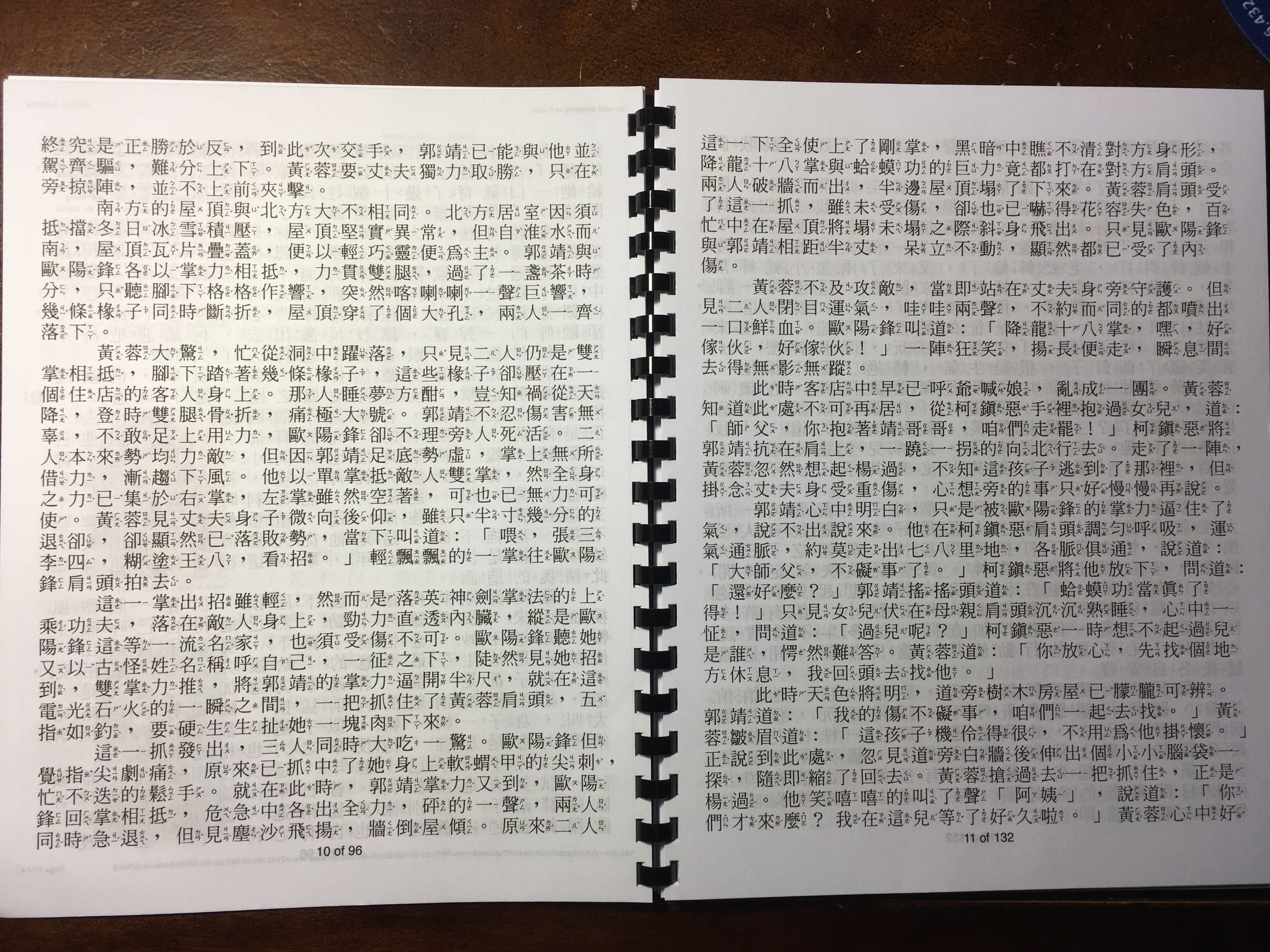
    2. Reading.  Read first the text with zhuyin or pinyin.  Print out text with phonetics yourself if needed (search for text, copy, paste, add phonetics – super easy).  A combination of reading to the child, listening to audio-recording, guided reading, read-aloud, and silent reading are great ways to speed up learning.  Then, read, read, and read.  Once the child can read the text quickly (different speed for different topics – faster for casual reading like novels, say > 500 characters a minute), it would be time to try similar text without zhuyin.
    3. Post-reading.  Discuss the subject, do brief writing/character practices, or do some artistic activities.

Below are two examples of SRE for Chinese:

#1.   My daughters learned in English about communities in the third grade and basic North Carolina history/geography in the fourth grade.  A couple of years later, I ask them to read the corresponding Chinese textbook from Taiwan.   It was still challenging for 9 year old “Georgia” due to the amount of new Chinese terminology but at least she knows some basic concept already.

image image image

Here is Georgia reading one such text, as posted a few weeks ago: https://youtu.be/-kuEJ0Crtgw.  She has yet to progress to reading such text without zhuyin.  That can wait.

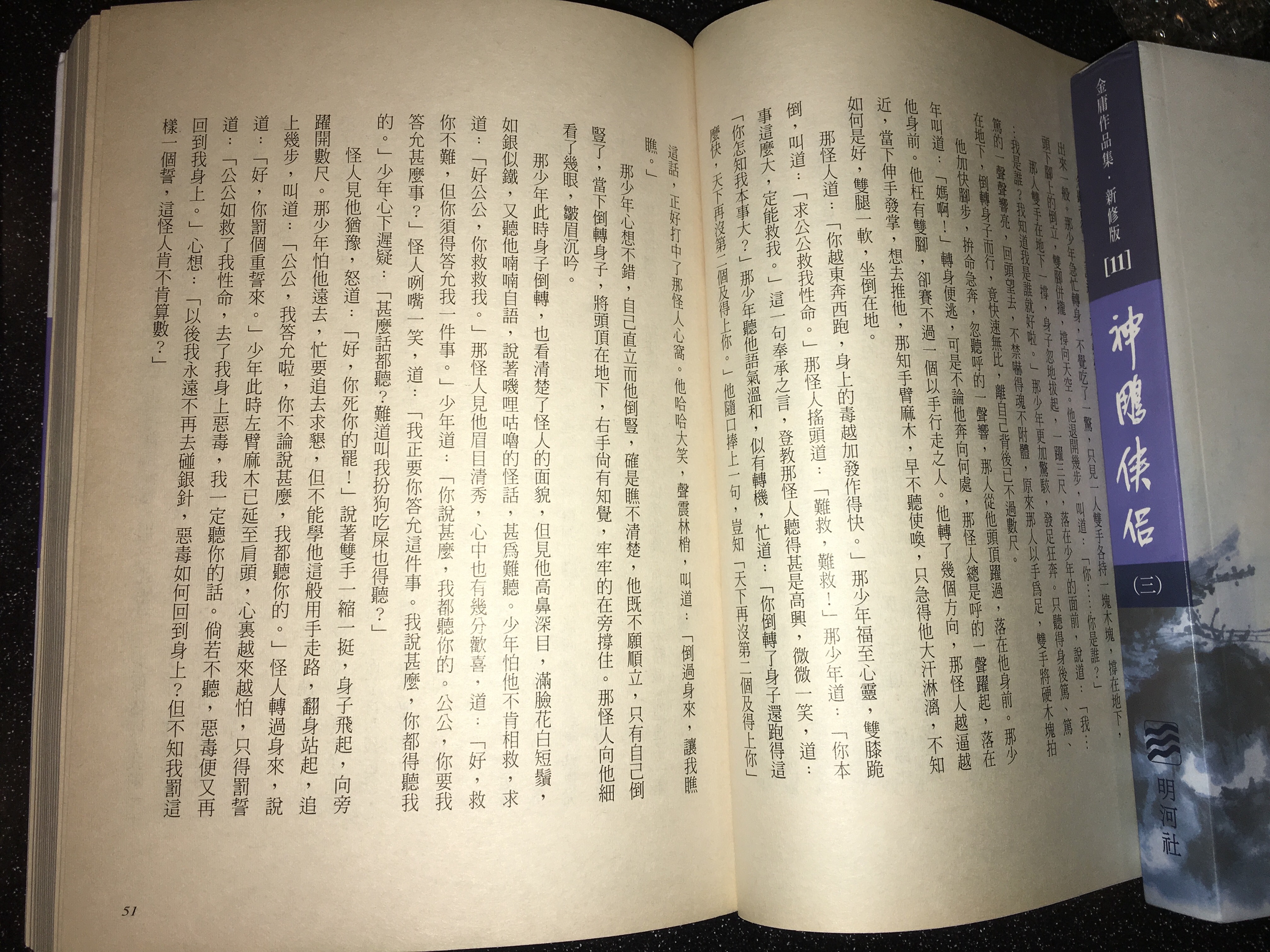
#2.  Charlotte started reading Return of the Condor Heroes earlier this month.

image imageimage

img_3813

Charlotte had watched the cartoon version several times a couple of years ago.  She read the dialogues in the novel just fine but has had difficult with some passages and visualizing the fight sequence.  So, I printed out the text with zhuyin and asked Charlotte to read it aloud with the tutor, who then explained whatever she didn’t understand.  After doing so for about an hour and half over two days, Charlotte had much better mental picture of the story.  Now, instead of going back to the novel book without zhuyin, I have her read the text with zhuyin and she finds it much easier to read.  I will just have her read such text until she reads it very quickly and then go back to the novel without zhuyin.  I will ask her to do some read-aloud with me from time to time.


So, the above is SRE for Chinese in a nutshell.  I am certain many of you have utilized similar technique to various degree. I am simply laying it out in a somewhat organized fashion.


I hope this post is helpful.  Thank you for reading.


*   Michael F. Graves and Jill Fitzgerald, Scaffolding Reading Experiences for Multilingual Classrooms.   

Last stage, for now

如今十二歲的大女兒已開始讀金庸的神鵰俠侶也開始可用電腦打自己的創作,她的大學前的中文學習似乎也到的最後ㄧ個階段。在接下來的三年,我們目前計畫大致上如下:

  1.  繼續念台灣小六的自修中文課本,多念些介紹中國文化的文章。
  2. 七年級的暑假加強用打字寫作。同時,因她喜歡寫作繪畫和彈吉他,也試編寫和畫雙語童書和學吉他自彈自唱中文歌。
  3. 八年級的暑假學讀簡體字和加強論說文,說明文等非記敘文的文章。
  4. 九年級的暑假由親友安排去台灣或大陸打工ㄧ個月。
  5. 十年級準備考Chinese AP test。學到這階段,這應該不難。

在大學前中文學習進入尾聲時, 她也可重新學習九歲時中斷的西班牙文。

  1. 七年級完後的暑假念五十小時的西文。
  2. 八年級週末念些西文文章。
  3. 八年級完後的暑假念八十小時的西文。
  4. 九年級上西文二或三的課。
  5. 九年級完後的暑假念四十小時的西文。
  6. 十年級上西文三或四的課,之後西文應有ILR第二級的程度。
  7. 十年級完後的暑假由親友安排去我國高中時住的多明尼加去做志工服務ㄧ個月。
  8. 十ㄧ年級上西文四或大學的西文課程,之後希望有~ILR第三級的程度。

至少,這是現在計畫的進度。當然,計畫常常趕不上變化。就再看咯!

Now that 12 year old “Charlotte” starts reading 金庸’s 神鵰俠侶 and can type her own creative writings, I can see the beginning of the last stage of our pre-college Chinese language art (CLA) journey.  At this point, I foresee that this last stage will last three years, from 7th through 9th grade, as follows:

  1.  Continue studying 6th grade self-study guide over the next two years.  It takes longer for my elder daughter, since she has heavier school work.  At the mean time, continue reading novels, concentrating more on original Chinese novels instead of translated ones, and doing read-aloud of literary work and cultural studies with the Chinese tutor on the weekend.
  2. Summer after 7th grade: focus on Chinese composition (by typing).  She will hopefully work on bilingual children’s book, as drawing/painting and writing are two of her passions.  With another year of playing/learning guitar, a favorite activity, she will hopefully work on making covers of Chinese songs (she is playing 時間都去哪兒了 tonight).  She is receptive to voice lessons.  So, we’ll see.
  3. Summer after 8th grade: learn commonly used simplified characters and do more non-fictional readings.  After going over the basics, it should be fairly straight forward.  One simple way would be to read fluently articles on www.slow-chinese.com and www.thechairmansbao.com first in traditional and then in simplified characters.  These articles are suitable for HS students and adults, not kids.
  4. Summer after 9th grade: one month of summer job in mainland China and Taiwan alongside other natives through friends and family.
  5. Studying for and taking the Chinese AP test should be fairly easy in 10th grade.  She will be “wrapping up” her pre-college CLA journey while most heritage students are just ramping it up in 9-10th grade.
  6. Continue reading Chinese novels and enjoying CLE after all these.

This “last” phase of our pre-college CLA journey should be the first phase, or more accurately, resumption of our Spanish language art journey.

  1.  Summer after 7th grade: resume Spanish home self-study and home tutoring.  It’s fairly easy to find suitable tutors.  Current plan is for ~ 50 hours of study.
  2. 8th grade: read/study more Spanish on the weekends.
  3. Summer after 8th grade: Another ~80 hours of study.
  4. 9th grade: HS Spanish II or III.
  5. Summer after 9th grade: ~ 40 hours of study.
  6. 10th grade: Spanish III or IV.  By the end 10th grade, she should be IRL level 2.
  7. Summer after 10th grade: hopefully one month of immersion volunteering trip in the Dominican Republic, back in the home country of my teenage years.
  8. 11th grade: Spanish IV or college Spanish.  She should be close to ILR level 3 by then.

Of course, like all “good” Asian parents, she has time for some fun (she loves sleep-overs and hanging out with her friends – who wouldn’t.) and to work on other subjects, activities, and tennis, her sport of choice.  Lastly, she reminds me that I promised her equestrian lessons this summer, another favorite activity from several years back, for achieving her target grade so far this year.  Thank goodness lesson cost is reasonable in our neck of the wood in relatively rural eastern NC.

Well, at least these are the plans.  We’ll see how it goes.  I can’t wait.

~2/3 CLE exposure time for ILR level 3 or above

Over the last few days, I revisited my prior observation that a minimum of 50% exposure to CLE (Chinese language ecosystem) before age of 8 is required to reach ILR level 3 or above in terms of speaking proficiency.  Having seen how a few of the younger fellow parents’ children have blossomed in terms of their Chinese proficiency over the last two years since I started my FB group Raising Bilingual Children in Chinese and English and joined 中英文雙語並進的養兒育女手記 another similar group composed mainly of adult immigrant parents, I reached out to some of them and made revision and refinement to my observation and expanded it to specifically reading proficiency.

Now, there are very few parent members of my FB group having pre-college children with ILR level 3 or above in terms of reading proficiency above the age of 9 or so, except for my daughters and maybe a couple of other children.  The main reason, I believe, is as follows:

  1. Few success stories.  There are few heritage parents who were as “aggressive” in pursuing reading proficiency for their preschoolers around 6-10 years ago – so there are few “success” stories to share by their tween/teens.
  2. Selection bias.  Most heritage children older than 8-9 learning Chinese have speaking, reading, or both IRL proficiency level lower than 3, and most those parents are resigned to the “reality” that their children will not achieve ILR level 3 or above in the foreseeable future, without spending extended time in the “motherland”.  So, these parents don’t seek out and join FB groups such as the two mentioned.
  3. Social media usage bias.  There are likely fewer older heritage parents who use FB or other social media.   Also, adult immigrant parents from mainland China may use WeChat or other social media sites more, seeing that Facebook is not accessible in China.   So, that is another selection bias.

My observation shifts as I gather feedback from other parents and their children.  So, please give me some feedback!

In any case, with these biases in mind, my current observation is as follow:

I)  Speaking proficiency.  It takes a minimum of ~66% exposure to CLE from at least 3 to 8 years old to achieve and maintain speaking proficiency of ILR level 3 and above between those ages.  That would be about 2/3 of the waking hours immersed in CLE.  The higher the percentage, the higher the IRL level.  Having said that, a children immersed in ~ 66% CLE time probably can achieve ILR level 3-3.5 by 8.  This does not necessarily extend to higher age groups, at which time language complexity and range of expression is increased.  To maintain or increase age-matched ILR level would require additional instruction and/or exposure to active/passive usage of more advanced vocabulary and expression, such as spending extended time with pretty much native level speakers or consuming multimedia programs (video/audio).  In addition, active learning/instruction likely decrease the CLE % time requirement.

A child can be doing an English based assignment at home but communicates to the parents or care giver in Chinese.  I would include that time as part of CLE also.  However, watching English TV programs at home likely would not count.  On the other hand, watching Chinese TV programs at an English speaking household would count as part of CLE.  The main determinant would be whether the child is actively using or learning Chinese.

  1. Chinese immersion schools count as 50% CLE for those hours at best, as the children plays in English and active use of Chinese is mostly done by the teacher, according to my understanding.  Past second grade, this percentage likely decreases as more English is used and added to the curriculum.
  2. Half day preschool counts as 1/3 of the waking hours.  Full day school counts as 1/2 of the waking hours.  Don’t forget to include the weekend, holidays, and winter/summer break.  Generally speaking, there are 180 days of school instructions.
  3. With the above understanding, for non-Chinese speaking families, full day Chinese immersion school since kindergarten only counts as no more than 15-20% CLE time (50% CLE efficiency x 50% of each day x 50% of the year) without additional enrichment, with some homework/studying time added in.  That’s why immersion school by itself is insufficient to achieve proficiency level of ILR level 3 or above.
  4. Heritage children at Chinese speaking household who attend English only schools likely have “maximum” 75% CLE time, but likely frequently get much less, if they consume mostly English based multimedia and play with other children in English.  Their proficiency frequently go dramatically downwards past 6-7 years of age as the slower pace of Chinese language instruction they receive at weekend Chinese school is not enough to maintain age-matched IRL level 3.  These children mostly speak English or a mix of English and Chinese (“Chinglish”) to their parents, who speak Chinese to them.
  5. Heritage children attending Chinese immersion school with Chinese speaking household can have up to ~80% CLE time, if Chinese is strictly used outside of school.  However, the slower pace of Chinese instruction at immersion school to accommodate non-heritage children will likely decrease their age-matched IRL level over time. Extracurricular activities conducted in English can put a big dent on CLE time but that is the case for any children.
  6. My daughters who have had spent half of their days in English only day care, home day care, preschools, kindergarten and up since birth pretty much (except for ~ one year and half when we homeschooled) plus sojourns abroad in Taiwan with 100% CLE, probably have CLE time of ~ 70%.  They receive Chinese instruction at home using Chinese language art curriculum from Taiwan at relatively fast pace in terms of reading (~1/2 to 2/3 of the pace in Taiwan, foregoing most of the writing practices) and consume Chinese multimedia in “concentrated” form (and thus less time consuming), as I gathered for them multimedia that highlight the intricacies and salient features of the languages in its various forms.
  7. Heritage children who are homeschooled in Chinese in Chinese speaking household likely can achieve CLE exposure time north of 80%.
  8. Multi-ethnic children with one Chinese speaking parent who are homeschooled in Chinese but exposed to parents communicating in English and who communicates to one parent in English and the other in Chinese probably have CLE exposure of ~ 60-70%.
  9. Multi-ethnic children who attend Chinese immersion school with one non-Chinese speaking parent may achieve ~40-70%, depending on the amount of Chinese used at home and extra Chinese language based enrichment, including playdates.

With the above in mind, it seems general English speaking proficiency of ILR level 4-4.5 “only” requires ~ 20-30% exposure time.  If one lowers the standard to ILR level 3-3.5, exposure time of ~15-20% will likely suffice for English.

The above brings to mind that bilingual proficiency in English plus another category 1 language in a household where both of those languages (say, English-Spanish or English-French) are used is relatively easy, compared to English-Chinese bilingualism.

As for trilingual families, a child attending English speaking schools in English-French-Chinese household where the parents speak in English and one parents speak to the children in Chinese and the other in French can achieve ILR level 5 (native) in English and French, at the expense of Chinese proficiency, since CLE exposure time would likely be less than 50%, which would tend to decrease further as child grows older.  On the other hand, a Chinese heritage child with Chinese speaking parents attending English-Spanish immersion school may have up to 70% CLE time if Chinese is strictly used at home.  However, further maintenance of Chinese ILR age-matched level past ~ 8 can depend on Chinese language instructions.  Similarly, a trilingual-biracial family (say, Polish-English-Chinese) in Taiwan who homeschools in the three languages may achieve CLE time of ~70%, which may indeed be sufficient for trilingual proficiency at or above 4 in all three languages over time.

My observation that it takes ~ 66% language ecosystem exposure time to achieve Chinese ILR level ~3 speaking proficiency vs.~15-20% exposure time for English (or French, Spanish likely) to achieve similar IRL level, or a ~4 fold difference, would be in line with what the Foreign Service Institutes of the US Department of States suggested (~ 4 times as long) for English speaking adults to learn Chinese to ILR level 3 vs. a category 1 language.

(to be continued……)

Flash cards

Many parents tried flash cards to teach Chinese reading.  I certainly did for my elder daughter “Charlotte” when she was ~3-4 years old, now 12, but not for my younger one, “Georgia”, now 9.  And many will continue to do so.

Regardless of the merit of flash card, I think there is a potentially interesting way to try flash card to “accelerate” Chinese reading for a few anxious parents, based on the work of Glenn Doman (1919-2013), founder of The Institutes of the Achievement of Human Potential outside of Philadelphia, and co-author of a series of “The Gentle Revolution” books, such as “How to Teach Your Child to Read”.  The flash card part of the Doman method, as it is called, is based on using BIG flash card to teach infants and toddlers to read, do math/arithmetic, recite knowledge, etc.  The institute also works to rehab “brain injured” children through pattern therapy, with criticism of effectiveness; but that’s a different story.

I had the pleasure of meeting Glenn Doman around 2003 in one of the courses the institute offers.  Here is one of his videos:

In terms of the Doman flash card method, it is best to start at 0-24 months old, the earlier the better.  Repetition and quickly (1 second or less) going over the cards are the name of the game.  As with all things, preparation often takes longer than the “instruction” itself.  Here is one non-offical website that points out the salient aspects of the method.   To modify the program to Chinese, I think parents can start with radicals, then character, words, and finally sentence (sequence of cards).

Do I think it’s an overkill?  Yes.  Do I think it is necessary?  Absolutely not.  Do I think it can work for its intended purpose of accelerating character, phrase, and sentence recognition through pattern recognition?  Yes.  Do I think it can make a great reader out of your child?  Yes, and no….  That will depend on the CLE, amount of reading practice, and the effort/priority you place from the time your child is ~ 4-12 years old.

I sure would like to see someone try.  It will certainly make a very interesting and instructive blog (+ business opportunity?).


Chinese-Spanish-English immersion

A fellow parent’s child rearing experience points out an interesting concept on raising children to be trilingual in Chinese, Spanish (or other category 1 language), and English.  This probably applies best to Chinese speaking household where English is not used much.

  1. Have the child attend Spanish-English immersion school starting kindergarten or earlier.  There is a good chance English will start to be introduced around 2-3rd grade.  Spanish is easier to learn even compared to English, and the child can read chapter books fairly early in early elementary school.
  2. Do lots of Chinese homeschooling with CLE (Chinese language ecosystem) at home as discussed before.  Get reading level up quickly as described before.
  3. Minimal or no English at home.  Since the child has not formally learned English at school and does not get to speak English at home, he only gets a little of English exposure and won’t be as comfortable playing with and interacting with non-school individuals in English.  The goal is for the child to prefer Chinese outside of school.  At school, it is mainly Spanish.
  4. When English is introduced and taught more and more at school, the child can learn English fairly readily, due to its similarity with Spanish and with all the English ecosystem outside of school and home.  After a few years of learning, the child’s English may get close to that of monolingual kids.
  5. The overall “scheme” is to for the child to learn an easier (but closely related to English) minority language at school and a difficult minority language at home.  Then, add English, the community / majority language, at ~ third grade.  Of course, time constraint will, as always, be the main factor in determining the proficiency of the various languages.  There is still no getting around needing to cut back on other commitments if the child is to have equivalent proficiency in English and Chinese compared to other children (matched for age and intelligence) learning just English and Chinese but not Spanish.  But, when the other children start putting time into learning Spanish (or other category 1 language such as French) in middle school or high school, things can even out, with better Spanish accent to boot.

Reading/writing, subject/language

In our bilingual journey, I made two observations that are likely different from the commonly used pedagogy for Chinese immersion schools.  The following assumes that the goal is IRL level 5 (native level) for English and IRL level 3 or greater for Chinese by end of high school.  I appreciate any feedback.

1.  Reading and writing.  Get reading proficiency high first, so that the child can enjoy entertaining readings in Chinese around the time he develops stronger and stronger English reading.   Enjoying CLE (Chinese language ecosystem) in greater depth does not require writing but requires decent reading proficiency.  Since all these reading practices takes time, which is often the most precious resource, I recommend not spending nearly as much time doing writing early on.  Also, the reading part of the CLE would be mostly narrative readings.  When the child can read youth and/or young adult novels proficiently hopefully by/in middle school, start doing more expository readings and then start doing more writing and typing.  Composition is the typical “highest order” skill, used to narrate, explain, or persuade.  I would be more than happy if my children can compose decently well in Chinese by typing instead of writing everything out.  But of course, they need to know how to write basic characters and how to write any characters presented with the correct stroke order.

Don’t get bogged down with trying to learn much reading and writing at the same time and then end up with only IRL level 1-2 on both end due to lack of time.  Get reading proficiency high to IRL level 3-4 as soon as possible and then come back to work on writing.  One’s writing proficiency is almost never as good as one’s reading proficiency; so, getting reading proficiency high first.  Then, the child will have a much higher chance of writing Chinese using the correct Chinese syntax and expression, rather than “Chinglish”.

However, if the community ecosystem has a strong Chinese language presence (not saying it is dominant) with decent CLE built in and the overarching schooling assessment takes bilingual education into account, such as in Singapore, then simultaneous emphasis on reading and writing can work well.

2.  Subject language learning.  These are the more “technical” vocabulary and expression in different subjects, mainly science and social studies.  The child’s Chinese proficiency almost always lags behind his English proficiency, particularly past third-fourth grade.  Not to mention that annual standardized testing and assessment are mostly done in English.  So, it makes sense to learn these subjects using the more proficient language – English.  It’s much faster too, as the child won’t be bogged down by inadequate Chinese proficiency.  After a year or two, come back to do some reading of these subjects, in Chinese.  This second part is to learn the terminology in Chinese but not the subject itself, since the child already knows the subject in English.  In this fashion, we separate subject learning from Chinese language learning and use the English language ecosystem to our advantage.

相聲 & other videos

As part of our CLE (Chinese language ecosystem), my girls watch quite a few entertaining YouTube videos, many of which have cultural references, either historical or current.

The following is a stand-up routine from Taiwan back in the late 1980s, with references to historical and cultural events in Taiwan and mainland China from ~ 1940s to 1980s.  My girls and I watched this a couple of years ago and we are re-watching it tonight.  It’s really funny.  They should learn something different every time they watch it.

Along with explanation, educational programs such as China: A Century of Revolution, and movies such as 末代皇帝 The Last Emperor and 霸王別姬 Farewell To My Concubine, I hope to give my daughters some idea of the events of those era, some of which were intimately tied to how they came to this world in the first place.


Below, I also list a few of the YouTube videos, movies, and TV series we had enjoyed over the past 5 years.  These really help them solidify their interest in the Chinese language.

Avalon of Idaho:


Jesus of Spain:


老外看中國


The PG version of You Are The Apple of My Eye (那些年,我們一起追的女孩).  The link below is a PG-13 version instead.


Secret (不能說的秘密)


重返二十

致我们终将逝去的青春

神雕俠侶 cartoon!   The first kungfu cartoon series they watched about 5 years ago.  This is the first time I find it on YouTube!


倚天屠龍記


笑傲江湖  


Of course, I try not to miss out on American culture as well.  Here is one excellent series of the Civil War era featuring Patrick Swayze: North and South.  It gets agonizing to watch toward the end since more and more misery pile on.  My wife and I could not finish watching it a decade ago and neither can my elder daughter and I a year to two ago.