Classic Chinese poems 唐詩

唐詩:下課坐車時ㄧ個禮拜讀ㄧ首,每天花1-2分鐘而已。

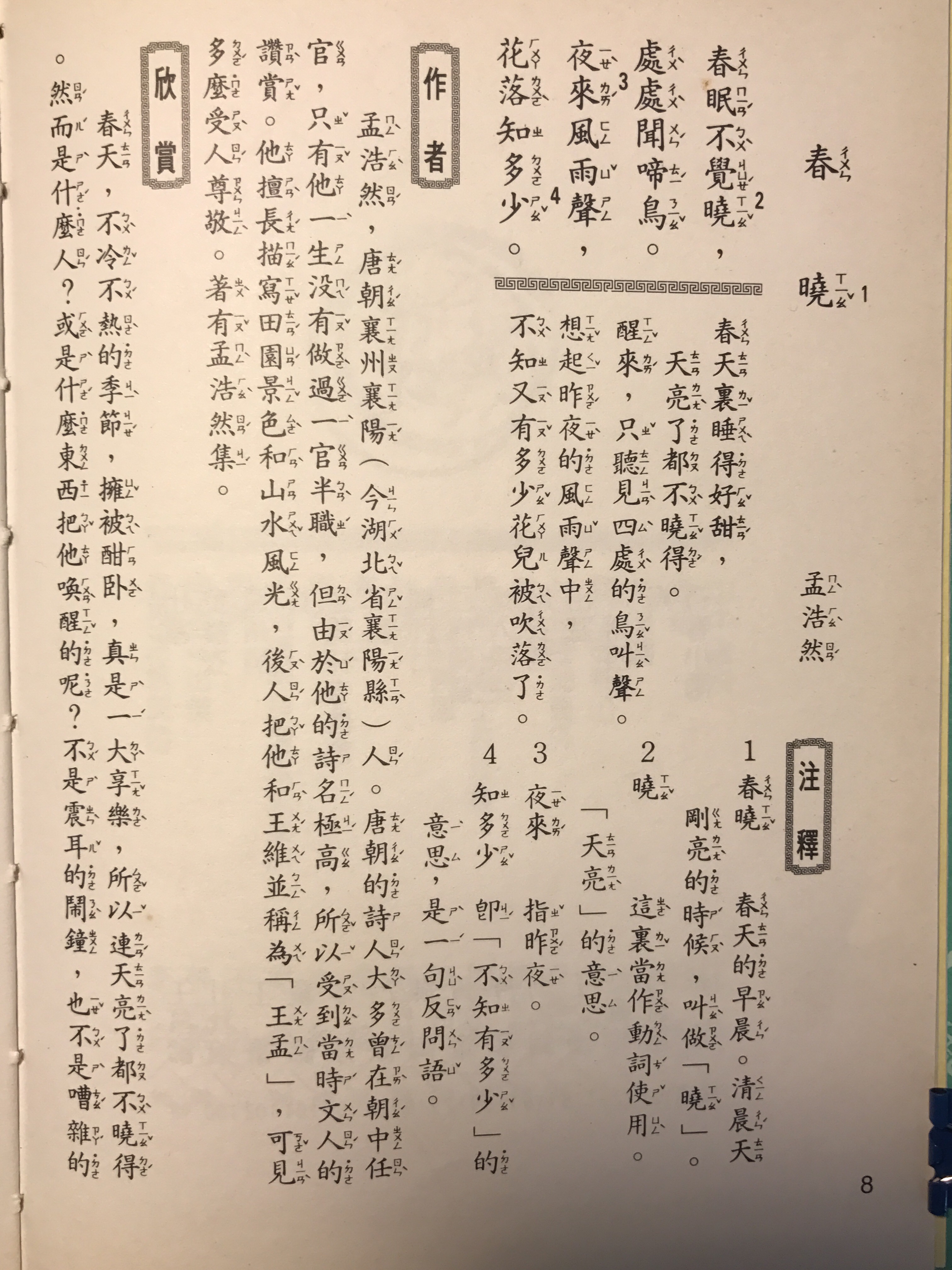
I have started using this particular book for my dds (10 year old “Georgia” and 13 year old “Charlotte”).  It was published in 1991 and was probably a used copy that a friend gave us a few years back.  My girls have memorized a few poems before and did a Chinese stand-up comedy a couple of years back.  So, they are familiar with classic Chinese poems.  We are using this during their car ride back home from school.  I simply have them read one new poem a week and they each recite the poem about 5 times a day.  All it take is about one to two minutes a day for each girl.  There is well written explanation on the pages.  I read the poem ahead of the time myself, as my knowledge on the subjects is fairly limited also (maybe about twenty poems).  I make sure to explain to them the poem myself the first day they read it.  I don’t need them to memorize the poems this first time around, but they can memorize it somewhat by the end of the week.   So,  1-2 minutes a day in the car, easy peasy.


This is the first poem.  They know this one already, as likely do many children.  So, we skipped ahead.


This is the second poem, which they read last week.  Nice and easy to understand.


This third poem, they know already.  So, we skipped it this week.


They are reciting this fourth poem this week.  It is another easy to understand poem.  After all, this is a book for kids.


If things go well, we can go through some 30-40 poems in a year, when school is in session.  That will more than I knew myself as a kid (and now, LOL).  We will come back a second time next year and they will be able to memorize the same poems readily then.  What’s the purpose of learning classic Chinese poem?   I don’t think they are on the AP Chinese exam.  But, we don’t learn Chinese for testing purposes.  It is just to have a deeper understanding and appreciation of the Chinese culture.  In addition, they will learn broader usage and definition of Chinese characters and words as well.  Benefits on the side: they may be able to better understand the lyrics of some of 周杰倫 Jay Chou’s songs, but not for the fact that one simply can’t understand his enunciation!

三十六計之第十計: 笑裏藏刀

No. 10 of 36 Stratagem: Hide a knife behind a smile.

Chugging along, 10 year old “Georgia” finally got through reading and recording stratagem #10.  Since we started reading this series in October, she averages recording one stratagem every two weeks.  At this rate, it will take us till the end of this year to finishing reading and recording all thirty-six stratagems.  But it is well worth it.


The modern Chinese culture and language of love

My dds and I have been watching Taiwan’s 2015 romantic comedy TV series “Love Cuisine/料理高校生” (available on YouTube or Netflix, both with Chinese subtitles) for the past month or so and they are loving it, particularly my 10 year old.  It’s pretty funny and there are so many good lines.  The romantic gestures and culture demonstrated by the two ~ 30 year old protagonists are very wholesome (i.e. conservative), probably comparable to secondary school level.  I didn’t know Taiwan can still be so conservative on screen.

You might ask, why am I spending all these time watching TV shows with the girls, given I have tons of other things to do.  Well, I am the facilitator and instructor for their Chinese within our small Chinese social group of three (and their only social group of this nature and Chinese proficiency level).  So, I have to know what’s going on so that they can share with me the various things they learned from their CLE (Chinese Language Ecosystem).

https://youtu.be/NeSH2HUFR6Y?list=PLtCtE7nFgWjJEF9YiS9tP2t-tQjsYG45T


After listening to scripted dialogues for the past month, however funny they are, I figure it would be good to introduce real life dialogues of love and lost in China or Taiwan.  So, I found a couple of reality TV shows in China and showed a couple of segments to my dds, though they are primarily meant for my teenager.  In this first video lasting 15 minutes, a young lady’s raw emotions were laid bare after she learned that hers was an unrequited love and the man she loved all these years has married already.  In just 15 minutes, the show host and the guests used languages involving young love, excitement, expectation, shock, devastation, and closure.  Shaken somewhat by the raw emotions in Reality TV, my teenage dd was nevertheless captivated and asked to see other segments.  I can see how some parents may think it is too early for her to watch such program but that’s another topic.  Regardless, it seems to be a very “efficient” way to learn this aspect of the Chinese language.  I also see teaching moments in these shows for my dd in terms of what NOT to do, given the hosts invite guests with the most intense stories.


https://youtu.be/r1oB3rWlwTU

三十六計之第九計:隔岸觀火

It’s been a while since I posted another reading of 三十六計 by 10 year old “Georgia”.  She has been working more on math lately as she is hoping to enroll in Algebra I next year.  Here is stratagem #9.  It’s incredible that anyone thinks that such story is appropriate for little kids.  Regardless, these readings are fantastic in terms of learning Chinese, as they contain a large number of new vocabularies and expressions in such a short story.

Maintaining interest

Over the years, my daughters (10 & 13) had watched a number of kungfu TV shows, which certainly help pique their interest in the Chinese language.  Recently, the benefit of those TV shows seem to have run its course and I figure it is time to watch some modern drama that explore cultural issues and employ languages  (as in language usage) more relevant to their daily lives.

I therefore recently introduced them to Love Cuisine, a Taiwanese romantic comedy TV show with two culinary school teachers as the main romantic interests and teenage student romances as the side show.  There are 22 episodes, each about 80 minutes long.

Well, the show is a hit!  My dds love it from the very first episode!  They would scream with excitement or cringe at times watching it.  After watching just a couple of episodes, they were already talking to me and each other about the funny parts.  Riding in the car during our winter break family trip, I find them talking about the show for extended periods of time, all in Chinese of course.  The dialogue from the show, particularly the more dramatic ones, has visibly made a positive impact on my dds’ colloquial proficiency.  They are able to hold conversation in Chinese longer before having to code-switch to English, particularly when they talk about English based experiences.  One of the reasons is that my dds now have one more interesting shared experience to talk about, that are entirely in Chinese.  Another reason is that the setting of the show is a school with teenage students, young love, and your standard romance plot, which my dds (particularly my 13 year old) have increasing exposure to through multimedia and interaction with other middle schoolers (not personally, in terms of dating, of course, LOL).  It certainly helps that they are familiar with the general and peer group social interactions and overall surrounding in Taiwan through their sojourns and several short stints in elementary school there.

The point I hope to make is that, as the children grow up, it would be ideal that they have adequate language proficiency and cultural knowledge/appreciation to be able to take advantage of native multimedia programs that suit their shifting interests, which will further enhance their understanding, appreciation, and proficiency.  Being able to share these experiences in a social context help maintain the CLE (Chinese Language Ecosystem), even into their teens.  The CLE can continue to run parallel to the ELE, as long as the social context continue to provide a net positive experience.  (I can see that it may be much more difficult for siblings who are more than a few years apart in age or of different gender with very different interests.  Parents may have to help establish other social groups.)

Lastly, given that I explain to my dds the reason and method of my Chinese language pedagogy, my 13 year old dd understands that few peers share similar Chinese-English bicultural and bilingual experience, unless they are youth (1.25 to 1.75 generation) immigrants.  Furthermore, thinking ahead (and this part maybe controversial), she understands that a future non-Chinese speaking spouse for her will likely mean that either she will have to take substantial amount of time away from her career to raise her children in similar way, or that she likely won’t be able to replicate similar experience for her children, which of course, means that her children will likely have substantially lower Chinese proficiency growing up.  Certainly, having two Chinese speaking parents by itself in the US means little in terms of their children’s Chinese proficiency, but that’s an entirely different issue.

Progress updates

Here are the updates for what my daughters are doing in terms of their bilingual education

1)    dd#1 “Charlotte”:  She is 13 and in 8th grade of a regular private school in a small town in North Carolina.  She takes regular 8th grade classes (Latin, English, Algebra, NC History, Physical Science, guitar).  She does well in classes overall though they do take up a lot of time.  She participates in various clubs and extracurricular activities (MathCount, Battle of the Books, club guitar with high schoolers, NC history something, tennis during the fall, etc.).  With all the school work and activities, she only does a few hours of Chinese on the weekends, reading up on current trends in China (Slow-Chinese.com) and continuing reading kungfu novel 倚天屠龍記 when time allows.  I try getting her to sing Chinese pop songs with guitar accompaniment but she is not interested, as she can’t share that with her classmates at school.  Instead she is playing mostly English pop songs, cords and fingerpicking, though she plays a few Chinese pop songs and songs from Japanese animation 天空之城 (Castle in the Sky) and 霍爾的移動城堡 (Howl’s Moving Castle).

My plan for her Chinese is to get them in during the summer and see if the school can let her sign up for online Chinese IV and then Chinese AP in 9th and 10th grade.  There is no hurry to take Chinese AP before 10th grade, as AP content is high school/adult material though the Chinese language level is 4-5th grade.  She can then take Spanish afterwards.


2)     dd #2 “Georgia”:  She is 10 and is in 6th grade in the same school.  Since we didn’t have any decent gifted program here, we let her skip a grade a few years back.  She takes all the regular 6th grade classes and is doing very well in school these days without breaking a sweat.  Though she is in regular 6th grade math, I am trying to see if she can finish pre-Algebra on our own before the end of school year, so that she can be tested out and then take Algebra in 7th grade.  She does tennis and guitar also.  Since we drastically limited her computer access and took most of her Chinese comic books away a few months back (very unhappy about this, she is) to encourage more English reading, she has gotten much better in English.  She is almost done reading (eagerly so) the first 7 books of Harry Potter, probably 2 years behind similarly gifted peers.  Better late than never, of course.  Since gifted middle schoolers in school districts elsewhere with differentiated or gifted programs seem to be two years ahead in math and science (or more for the few highly gifted students) without needing to resort to grade skipping, we are working with Georgia’s school to see if they will allow her to fall back a grade to her age peers before high school but still take mostly advanced classes.  If the school approves of it, she will have a second 8th grade year though she will take mostly 9th grade classes.  In this way, she will have equivalent course load when compared to gifted students elsewhere at time of college application.  She then will be able to take calculus by 10th grade and rack up more AP classes this way.  I think she will be able to take both Chinese and Spanish AP this way.  Leveling the playing field, that’s all.  Otherwise, she is at a disadvantage when applying for the very top colleges, since they could care less about skipping one grade.

As far as Georgia’s Chinese is concern, this is going well though we are slowing down Chinese this year, to make room for English and math.  She continues to read 三十六計 aloud and reads the World Literature Series mentioned in prior blogs (currently reading Phantom of the Opera).  On the weekends, she reads Chinese stories such as 包公傳 and 聊齋誌異 and current trends in China (selected age-appropriate readings from Slow-Chinese.com) with the tutor.  We also continues to study 4th grade Chinese textbook from Taiwan at a slower pace.  Since she has had big improvement in English reading, I am “giving back” some of the Chinese comics that she loves (mainly 哆拉A夢 and 亂馬1/2).

The girls continue to speak mostly Chinese with each other at home, as I am frequently around (big brother is always watching!!).  Charlotte adds some English while speaking with me (and therefore I have to instruct her more in colloquial Chinese), as there is a lot of middle school drama that she tries to convey.  Georgia only adds English phrases every now and then and can mostly avoid adding whole English sentences.   I hope they can keep this up for the next 4-6 years.  Though they are actually 2.5 generation Americans, they act more like 1.5 generation in terms of their Chinese.  It gives us immense joy that everyone speak mostly Chinese with each other at home.

Lastly, we have been watching “Fresh Off the Boat” on Amazon Video and they love it, as it validates their own experience!  Georgia has been watching fewer kungfu TV shows lately as a result.  Next summer, besides the usual trip to Taiwan (a couple of weeks only this time), I will be taking them to mainland China for a 10-14 day educational trip.

Well, that sums up what we have been doing these past few months.  With running the household, parenting, and work plus primary hospital call every third day, I am getting kind of burned out after doing so for 10 years.  I plan to cut back to a part time position next spring for a couple of years, to enjoy my children for a couple of years before they don’t “need” much of me anymore, work on a few projects that I have been putting off for years, and, uh…., get that six packs that have eluded me for the past 25 years !!

Readings in Chinese current trends and culture

My daughters have been reading and discussing selections from Slow-Chinese.com on the weekend with their Chinese tutor.  The website has great articles on Chinese culture and trends in China, in both simplified and traditional characters.  They are appropriate for advanced readers age ~ 9 and up, depending on the articles.  I copied many of the articles down in traditional characters and added zhuyin so that my dds wouldn’t get stuck while reading them.  These articles are a fantastic way to learn about current Chinese practices.  Parents NOT from PRC need to know that the articles are written from the Chinese perspective.

Here is the PDF file: slow-chinese-articles-pdf


p.s.  If the authors from Slow-Chinese.com objects, I will be happy to remove the file.  I am thankful of their effort and website.