Magic Tree House

買了三套Magic Tree House 中文版給九歲的小女兒看,效果不錯,接受度高。一套12本,買了第一,二,四套。第四套字應該有第一套的兩倍以上。小女兒現在看到第二套第一本(其實她喜歡的,ㄧ本12-15分鐘就可以看完)。推~

I bought 3 sets of Magic Tree House for “Georgia”, set 1, 2, 4 (book 1-24 and 37-48). The last set probably has twice the number of characters as the first set; and hence more expensive. She’s done with the first set and is moving onto the second set. I am glad she doesn’t mind reading them; but really, if she likes the topic, she finishes one book in 12-15 minutes. We will see how she will respond to the last set, in terms of attention span.

Stranger in my own country

Well, we are now back to the same place  for “Georgia”, where “Charlotte” was two years earlier.  Georgia, now age 9, is three years younger but is now in fifth grade, the same grade when Charlotte found herself having difficulty interacting with fellow female classmates in her new new school after a year and half of homeschooling.  This new private school is about 90% Caucasian.

Back two years ago, my girls just finished about 20 months of “Chinese bubble” homeschooling with immersive CLE (Chinese language ecosystem), though they had extensive daily interaction with non-Asian adults, mostly Caucasian ladies who helped out with homeschooling and English reading.  As I later learned, a big part of the problem was classic bullying behavior amongst tween girls and the rest was unfamiliarity with ELE (English language ecosystem).  So, I helped Charlotte understand bullying pattern through books and a movie (“Odd Girl Out” – book & TV movie) and got her watching American sitcoms and listen to American pop music.  A year later in sixth grade, students move from classroom to classroom with different classmates each period and students are not longer stuck to the same group for the whole day.  So, Charlotte found her own group of friends and have been thriving since.  Her two best friends with whom she has sleep-overs are Caucasian.  In fact, she does not have Chinese speaking or Chinese heritage friends in our small relatively rural town.  Though she no longer has time for sitcoms, she gets her dose of American “culture” through extensive reading, movies, pop music, friends, and extracurricular activities such as tennis team.  Now that Charlotte is 12 and in seventh grade, I am glad to say that she feels proud of her bicultural identities.  I venture to say that she is equally at ease with non-heritage peers, heritage but English-speaking peers, and oversea Chinese speaking peers in Taiwan.  She does not expect her non-heritage peers to understand her CLE and has no interest in explaining it to them, as her experience of CLE is probably “too extensive” to explain.  Though many heritage children mingles just fine with other heritage and non-heritage children with English, extremely few achieve decent Chinese speaking and reading proficiency (ILR level 3 and above) under such circumstance.

Now back to Georgia.  Though Georgia has a couple of good friends in her fifth grade class, she feels so different from others and seems to be having a bit of a tough time.  It looks that it is time to put on my counseling / parenting hat again.  With a little bit of luck, all these will be water under the bridge in a year or two and my Georgia will thrive like her sister does.

So, is there a potential price to pay for building and maintaining a CLE?  You bet!  Can we overcome it?  Yes we can!

Article on bilingual identity issues from Japan


Shuang Wen School of NYC (雙文學校)

A member pointed out this public elementary-middle school bilingual program next to the Chinatown in New York City. Of the few middle school programs that I had researched, Shuang-Wen’s graduating 8th graders in 2009 have the best colloquial skill I have heard so far. A few of the students spoke really well (mostly girls) and I wonder if some of them are actually youth immigrant themselves. One girl said that she was only there for 3 months; so, she probably doesn’t count. Given it is so close to Chinatown, there is a good chance that the majority of the students are second generation children or youth immigrants, which make it easier in terms of instruction.

Halloween (萬聖夜)

在美國,每年10月31日的晚上是萬聖夜,中文常稱為萬聖節,是諸聖節的前夜。諸聖節是某些基督教派(大多是天主教)紀念聖人的節日,但萬聖節並非是基督教的節日。 現今, 小孩晚上會穿上化妝服,挨家挨戶敲門討糖果,說:“不給糖,就搗蛋!”。有些人會裝扮成鬼、巫婆、或其它嚇人的樣子。南瓜燈 、骷髏頭、 蜘蛛網和墓石為這節日普遍的裝飾品。

在美国,每年10月31日的晚上是万圣夜,中文常称为万圣节,是诸圣节的前夜。诸圣节是某些基督教派(大多是天主教)纪念死者的节日,但万圣节并非是基督教的节日。现今, 小孩晚上会穿上化妆服,挨家挨户敲门讨糖果,说:“不给糖,就捣蛋!”。有些人会装扮成鬼、巫婆、或其它吓人的样子。南瓜灯、骷髅头、 蜘蛛网和墓石为这节日普遍的装饰品。

In the United States, Halloween is celebrated on the night of October 31st, the eve of All Hallows’ Day or All Saints’ Day (Hallow = holy, saint).  All Saints’ Day is a Christian observance (mostly Catholic) that commemorates saints, though Halloween is itself not a Christian observance.  These days, children wear costumes in the evening and go to peoples’ homes saying “Trick or treat!” to ask for candy and sweets. People sometimes dress up as ghosts, witches, and other scary things.  Jack-o’-lanterns, skeletons, cobwebs, and headstones are common decorations for this holiday.

Kid’s audio by Georgia: 

(The purpose of such post is to provide children and parents with Chinese wording on things relevant to their lives here.  Any suggestions will be appreciated.)


單字表 (Vocabulary list)

萬聖節     万圣节     Halloween

基督教     基督教     Christianity

紀念     纪念     remembrance

節日     节日     holiday

化妝服     化妆服     costume

挨家挨戶     挨家挨户     going from door to door

鬼     鬼     ghost

巫婆     巫婆     witch

裝飾品     装饰品     decoration

骷髏頭     骷髅头     skull (technically)

蜘蛛網   蜘蛛网     cobwebs


Code switching

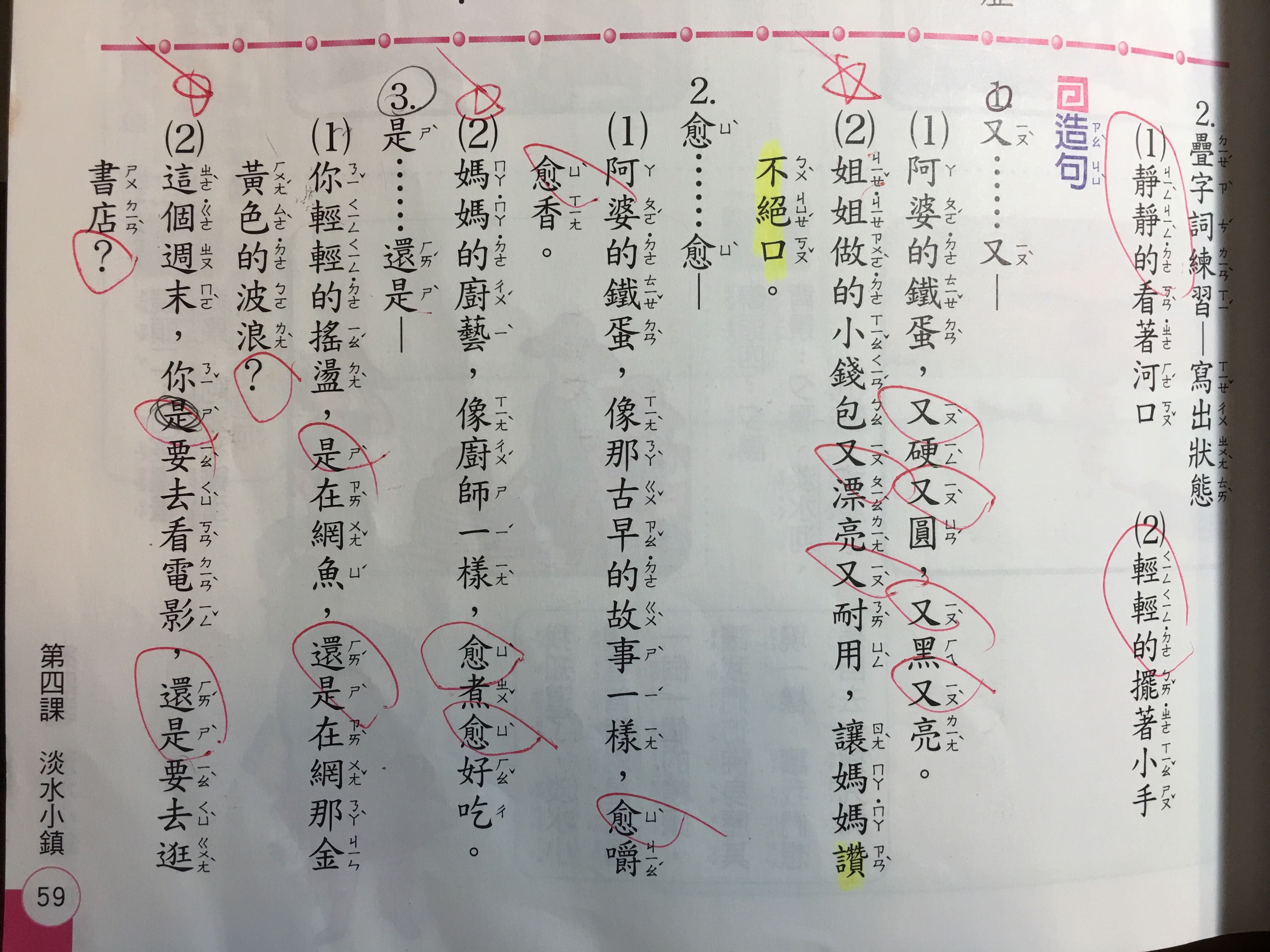
“Georgia” (9) has a stronger tendency to switch to speaking English, compared to our 12 year old daughter, “Charlotte”, who can pretty much express herself well in Chinese the great majority of the time. So, seeing that Georgia needs extra work on fuller colloquial expression, we hired a tutor to work with her on the weekend, one hour on Saturday and one hour on Sunday. She reads aloud story books with more colloquial expressions and conversations with the tutor.  The tutor also has Georgia make sentences verbally based on different sentence structures. After two months, she is doing better now.

Thankfully, Charlotte’s Chinese is strong that she continues to speak to Georgia in Chinese the great majority of the time and the two continue to converse in Chinese most of the time at home, where we continue to monitor and enforce the “Chinese Only” policy.

As I had written before, it is important that the elder child has excellent colloquial Chinese so that the younger child has a fighting chance to learn Chinese well enough.