Singapore vs. PRC primary school Chinese reading level

I have just read a number of discussions on Singapore’s education system and the Chinese curriculum there.  Singapore manages to pack a lot of learning for their students and has a world class educational system, as far as standardized testing is concerned.  As best as I gather, Chinese is taught as a stand-alone class, at most one period a day during school, as the rest of the school instruction are conducted in English.

In any case, I looked up some reading samples from Singapore.  Here is Singapore website published by the Ministry of Education in Singapore.  Click on a 高級華語 textbooks for the first semester of sixth grade.  The passages look very reasonable to me, for 6 years of daily one-period instructions with established CLE in the country.  I think my 9 year old should be able to read these in traditional characters or very close to reading them proficiently.

I then looked up China’s textbooks for first semester of sixth grade.  Here is one link what I found : 6th grade textbook.

It appears, to me at least, that China’s Chinese reading level is higher than that of Singapore’s.  That’s not surprising given, I presume, almost all classes are conducted in Mandarin Chinese in China.

So, once again, more exposure / learning = higher level.  Simple as that.
On multilingual kids in Taiwan


It is very doable to be raised trilingual in Taiwan in Mandarin Chinese (community language), English (the lingua franca of the world), and another mother tongue of one of the parent, if one parent is a fluent Chinese/English speaker and another parent is fluent English/the other mother tongue speaker, and the parents communicate in English.  These kids are likely biracial.  My brother’s family is like that and may even know this young lady.  So, my nephews are trilingual in Mandarin Chinese (and reads 金庸 novels too), English, and Danish.  They homeschooled a couple of years also.  They likely know a number of families whose kids do something similar, including another Taiwanese-Polish family.

I suspect many of these kids have some international experiences, like growing up abroad till around 6 and/or spend summer breaks abroad in the country of the third language (other than English and Chinese).  It helps when there are many international expats living in Taiwan whose children are native English speakers.  It probably helps when the third mother tongue is held in high esteem by the community.  My suspicion is many of these kids enjoyed some type of alternative schooling at some point, rather than attend 12 yeas of regular compulsory education through the Ministry of Education.  There are established homeschool groups that kids can join.

Learning multiple languages while growing up is not difficult, as long as there is a ready community/resources that supports such development and measure proficiency according to multilingual standards.  Many populace around the world do this all the time.  What is difficult in the US for kids to learn English and a category V language is the lack of such ready community/resources, with English as still the lingua franca of the world and the amount of time needed to be develop higher level competency in the category V language early on.  The difficult task for US families is therefore to “artificially” create such community/resources, or the CLE (Chinese language ecosystem) that I talk about.  Obviously, if parents enroll the children in traditional schooling and want the children to “excel” in the various academic and nonacademic activities that other mostly monolingual kids participate in, that put further time constraint in the picture.

下ㄧ代 (Next generation )

An older adult immigrant parent once commented something along this line, “Why spend so much effort teaching the children Chinese?  Their children won’t be able to speak Chinese anyway.”  What she meant was that second generation heritage children mostly achieve low Chinese proficiency level; so, their own children (3rd generation) practically have little chance of learning much Chinese at all.  The “line” will be broken anyways.

Well, that was NOT my plan from the beginning.  我自己是第ㄧ代半.  I am a 1.5 generation immigrant, having emigrated at the age of 11, and my daughters are 2.5 generations.   I want something that is reproducible for the next generation.  I would say that my overall Chinese proficiency is about ILR level 4-4.5.  My listening should be close to 5, my general speaking 4.5, my reading 4-4.5, my writing (at least composition) – around 3.5 (I hope!).  I wanted my children to achieve level 3.5-4 in overall proficiency by the end high school.  If they continue to learn and read Chinese in college and their 20s, they should be able to improve further to solid 4-4.5 by the time they are parents.  When they raise their own children in Chinese and English, as they will be consolidating their foundation further.  My wife and I will even consider moving back to Taiwan for a period of time to hopefully care for our grandchildren (if any) for a few months a year for the first 6 years of their life, to help provide them a strong foundation in the Chinese language.  So, hopefully through similar path and with further technological advances, my grandchildren will be able to achieve 3.5 by the end of high school.

這樣,至少有可以承傳給她們的下ㄧ代。But that’s just me.

Characters recognition vs. reading proficiency

A parent’s question:  How many characters does one need to be able to read a children’s chapter book fluently?  An wuxia novel (e.g. Jin Yong)?  A newspaper?

My take on it:  There are characters, and then there are words/vocabularies and idioms, which are often combination of characters. On top of that is reading proficiency/fluency (with good comprehension of course), which takes practice, even if one recognizes all the characters and words.  In general, knowledge of 1,600 characters cover about 95% of the characters in regular mass media, at least for traditional characters, and that is generally considered the minimum to be considered “literate”.  Of course, one can know what certain characters/words mean when one reads them, but without knowing how to pronounce it. There are different levels of children’s books, chapter books included of course.  If I have to make a guesstimate, I would say it takes familiarity of somewhere around 600-1,000 characters to start reading chapter books, though reading proficiency / fluency takes practice over time.  A child who knows 1,000 characters and read a book at 500 characters a minutes with good comprehension has much higher overall proficiency than a child who recognizes 1,500 characters and reads the same book at 100 characters a minute.  Similarly, reading proficiently more advanced media such as Jin-Yong kungfu novels and newspaper written for regular adults (not abridged version for language learners) requires much more than character recognition.  There are words, phrases, idioms, background knowledge/concepts, and relevant cultural knowledge involved.  But, if you really want to have a number to work with, I would say knowledge of 2,000 characters is the minimum. In general, I think parents shouldn’t dwell on the number of characters the child knows but whether the child can read proficiently.  Reading proficiency is so much more than character recognition.

Q&A

Q: 你女兒的中文程度這麼好,那他們的英文程度呢?他們的中英文閱讀時間你是怎麼安排呢?謝謝

A: 大女兒ㄧ開始以中文為重,目標為七八歲前中文比英文強,才能流利都跟妹妹說中文。三年級後半開始加強英文(那時英文蠻爛的),花~三年時間把英文拉回同儕母語級,現在很喜歡看英文小說和寫作。

因有姊姊的中文教材及幫助,妹妹比姊姊同年紀時有較完整的中文環境。除中文寫作以外,小女兒中英文同等發展,中間差距較少。小女兒天賦不錯,跳一年念,英文閱讀寫作該跟同年學生差不多,但比大她一歲也資優的同年同學還差,但該會每年縮小差距。

女兒們吃早晚餐都會自己拿中文漫畫,小說來看,因文字不是障礙。我也會每星期撥些時間(~兩三個小時)給她們看中文故事書或小說。

在美國要小孩中英文都要夠強,兩個都需要。不是說就是要去上習班,而是需要有心及有學問人士來帶小孩克服些難關。可在7-8歲前以中文為重點,之後再英文。在家,女兒們的中英文由我負責,除指導以外,也替她們找中文家教(畢竟我只念到小五)。

依我的觀察,大學後才移民到美國的家長的英文會比較吃虧,因此他們可能比較不敢讓小孩慢點學好英文,所以小孩的中文學習可能會受影響,除非家長本身是在高中小學校就職,比較清楚美國的教育系統及教學。而本來是小留學生的父母(十二歲左右來的),因中英文都不錯,而且自己走過在美國學英文的路,比較不會擔心小孩英文不會學好,也比較能在適當的時間小孩的英文,所以可能比較敢放手讓小孩小時候多多學中文。


Q:請問你以前女兒小的時候,有要求她們寫字嗎? 還是一開始就花時間在認字閱讀呢?謝謝

A:基本寫字筆順從小都有訓練,課文單字也都有練習,現在要以背寫唐詩為主。大女兒明年暑假要以打字練習作文。

對在家有聽中文的華裔學生而言,我認為ㄧ開始同時注重中文閱讀及書寫是欠佳的。在三四年級時,能以閱讀中文漫畫或較有意思的故事書為娛樂是最重要的ㄧ節,不然就幾乎全被英文文學及多媒體拉了過去,大幅度的減低了對小孩而言學中文的實質意義(no relevancy)及興趣。因小孩事情也多,時間有限,我建議首先以認字閱讀及朗讀為主。到小說會念時,再來加強寫作(打的就可以了)。當閱讀朗讀多了,寫作自然會較好。可惜,在正規體系內為主的學習,都注重以寫功課或筆考來衡量成績及進度,影響大局。

Tiger cub of Amy Chua

I am sure you know who Amy Chua is, author of Battle Hymn of the Tiger Mother from a few years back. She hired Chinese nannies when her daughters were young.  My understanding is that Amy agreed to raise their children Jewish (her husband’s religion) but they had to learn Chinese.  Sophia, the elder daughter, just graduated from Harvard and should be attending law school at Yale, where her parents teach.  You can listen to Sophia’s Chinese in this video.  Though Sophia had a script and likely practiced her part beforehand, Amy did a good job, considering their circumstance.  It took me sometime to find this video back then.

Click on 7:20 and 16:00 mark for Sophia’s part.

 Interview of tiger mom and cub

我的少女時代

“免費”電影線上看-我的少女時代…… totally not saying anything about the legitimacy and quality of the video. But you will love it! My girls surely did.  Another hit for our CLE (Chinese Language Ecosystem)!  Sorry, boys may not be interested in this.

Go toward the bottom of the post where it says:
點我立即線上看電影
大結局→點我立即看免費線上電影結局

http://designbyjun.blogspot.com/2015/09/blog-post.html

Harry Potter

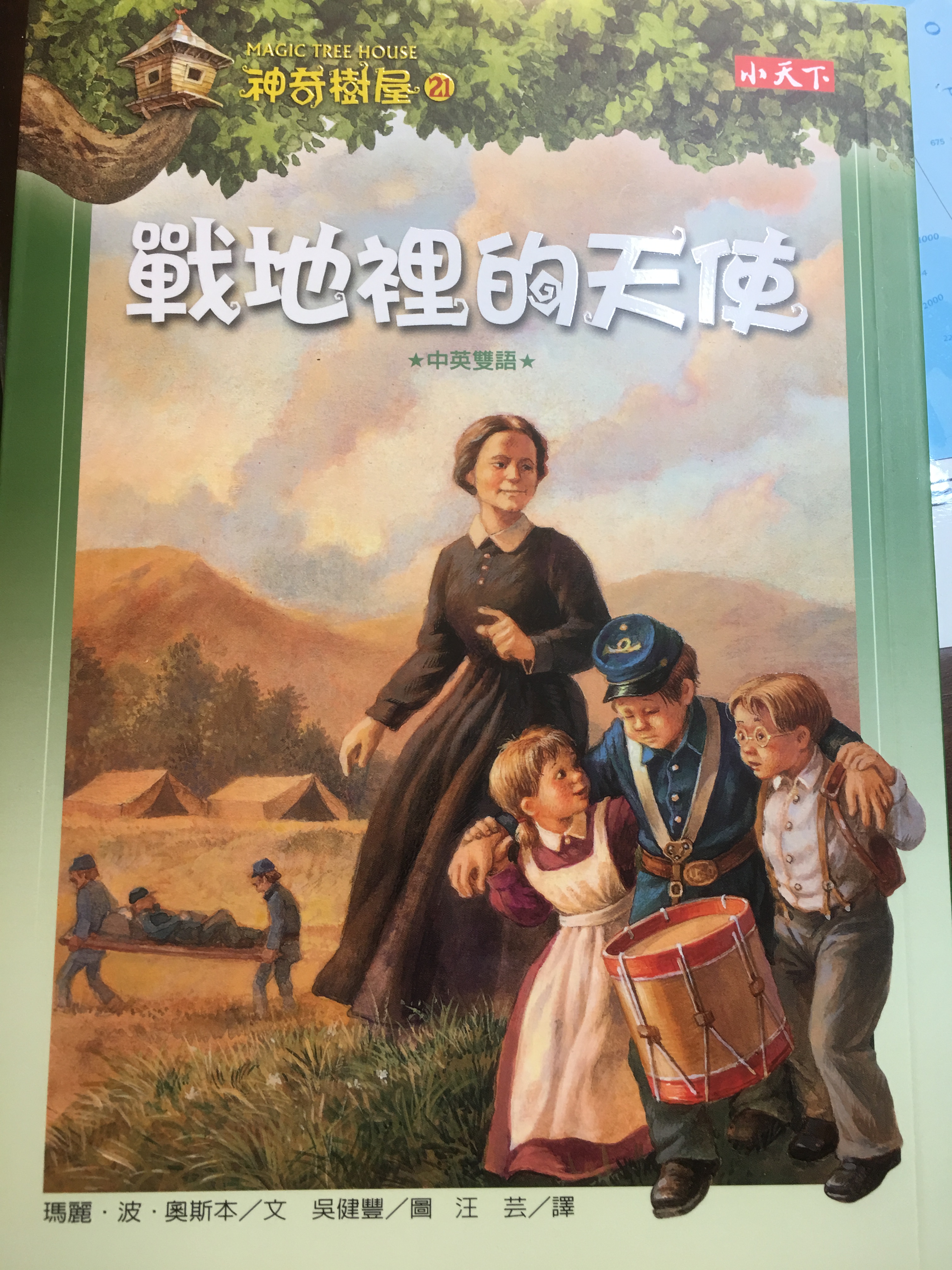
Finally I am able to get 9 year old “Georgia” to start reading more Harry Potter in English.  She is now working on the third book and read a chapter on Kindle every few days.  That’s not fast by any means but she will pick up more speed over the next year to two.  It’s a balancing act, to advance both Chinese and English reading at decent enough pace concurrently.  Georgia is able to do it decently well, since we have a solid CLE (Chinese language ecosystem) already set up, thanks to her elder sister, and a solid ELE from school plus my tutoring.  She finished reading the 21st book of Magic Tree House in Chinese in 8 minutes or so.  It’s ~ 100 pages but doesn’t seem to have many characters.  She has three more books to go before I had her skip the next dozen (book 25-36, which I did not buy) and move onto book 37, which is longer.  Hopefully, she will be one step closer to reading Chinese chapter books without zhuyin by the time she finishes reading Magic Tree House book #48.  Her sister “Charlotte” started reading chapter books without zhuyin at 10.5 years old; I hope “Georgia” get to do it at 10.

imageimage

Rate limiting factor: Time

With YouTube, internet, mail-order books, etc., gone are the days when learning materials and pedagogy are some of the major limiting factors for kids to learn Chinese well, particularly for families with resource and/or Chinese-speaking heritage families.  Time management, learning efficiency, competent bilingual-biliterate instructor at home (usually one of the parents), and priorities are.

We simply can’t get around the fact that there are only 24 hours a day.  Speaking proficiency depend largely on having the chance to practice speaking with others who have at least equivalent proficiency.  Certainly, read-aloud of conversational or more colloquial text certainly help.  Listening to lots of TV shows, like what “哈佛妹 Harvard Girl” Avalon and many others suggested, certainly help but requires the chance to practice speaking also.  Reading proficiency comes from having the chance to do plenty of reading.  All these require one thing – TIME!

Parents, once again, have to choose their priorities.  How important is Chinese and how much time should the children devote to Chinese, instead of other activities, whether they are academic or extracurricular pursuit?  To this end, time management and learning efficiency become ever so important, and having a competent bilingual-biliterate instructor available at home help tremendously.  How much “gap” to open and know-how of “closing the gap” in a timely fashion can therefore be of primary importance.

First vs. second language learning

Though many families do not set native-like proficiency as the goal and don’t need to, the statements below once again emphasize the importance of listening and speaking proficiency by 5 and then by 8.

Wikipedia: second language learning

“…..children by around the age of 5 have more or less mastered their first language, with the exception of vocabulary and a few grammatical structures.”

“In acquiring an L2, Hyltenstam (1992) found that around the age of six or seven seemed to be a cut-off point for bilinguals to achieve native-like proficiency. After that age, L2 learners could get near-native-like-ness but their language would, while consisting of few actual errors, have enough errors to set them apart from the L1 group. The inability of some subjects to achieve native-like proficiency must be seen in relation to the age of onset (AO). “The age of 6 or 8 does seem to be an important period in distinguishing between near-native and native-like ultimate attainment. More specifically, it may be suggested that AO interacts with frequency and intensity of language use” (Hyltenstam, 1992, p. 364).”