做好榜樣 Setting a good example

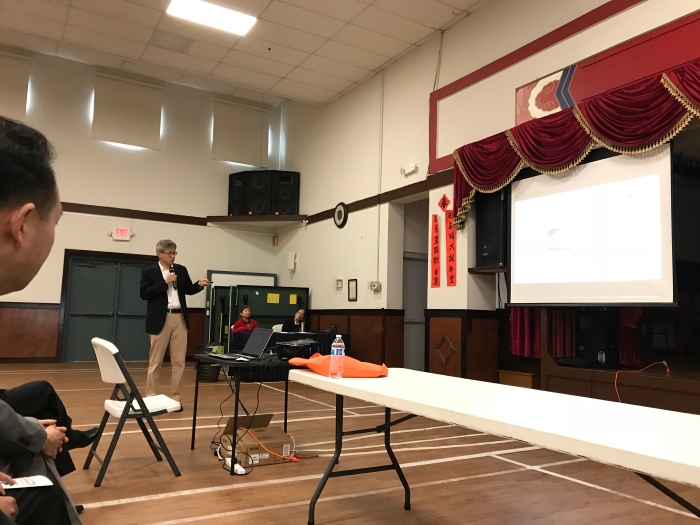
This post is, for a change, about me!  We moved to Georgia last summer and I was recently invited to give a 30 minutes presentation on chronic kidney disease to the general Chinese speaking public in the area.  All in Chinese, with a few English medical terminologies allowed in between.  As a youth immigrant, I learned everything from middle school and up in English, including everything in medical school and medical residency of course.  To my Chinese-speaking friends, family, and the few Chinese-speaking patients that I have had so far, I can say a few sentences about their medical issues in Chinese with little problem.  But to give a 30 minutes talk in Chinese about a medical subject, well, that’s a completely different ball game.  Besides it being a good community service and promotion for my medical practice, I figure that it would be a good way to let my girls see how knowing Chinese well can be a good way to connect with the local Chinese speaking community, even for youth immigrants like myself.  This talk would also be a good way to force myself to improve my own Chinese.

After getting all my slides done (in Chinese mostly), it took me more than 10 hours just to practice delivering this talk in Chinese.  Like any talks, I have to add in some jokes and interesting things to liven it up a little, in Chinese of course.  I also added a couple of Chinese idioms, proverbs, and a reference to an ancient Chinese medical story.  Public speaking was never my thing and my girls helped out, providing critiques during parts of my practice.  DD#1 “Charlotte” is a natural in public speaking and wrote several PAGES of notes for me.  She even suggested more suitable Chinese words for me to use, can you believe it?!  (She can compose in Chinese better than I can.)  DD#2 “Georgia” was just laughing her heads off, jotting down more than a hundred of my “uh…uh….” in just a few minutes of my initial practice runs!  I was starting to get very annoyed at her, LOL!  Since I had a busy work week, I stayed up till 4AM the day of my talk (Sunday) to practice.  In the morning, I practice two more times and felt fairly confident by the time we left the house.

img_2621

I was a little nervous waiting for my turn as I was to deliver the latter of the two talks.  An adult immigrant China and US trained physician delivered the first talk on cancer screening and treatment.  Well, my talk went very well, I am so relieved to say.  No more “uh….uh….”, LOL.  The audience asked many questions and a number of them asked me for my business card afterward.  My wife was very proud of me that I asked her “所以,妳認我是妳的先生了?!“ (So, you would now acknowledge that I am your husband?!)   LOL.  It took me a whole hour afterward just to feel all that stress leave me.

My girls were very proud of me too!  Mission accomplished!


img_2626


Question on assimilation and Chinese language learning

One parent asked on my FB group: I noticed many other parents have voiced concerns about social isolation in the quest for CLE (Chinese Language Ecosystem)……..  I am curious to hear from parents or parents of kids who are happily assimilated without compromising Chinese language/culture. Is this utopia possible for us in small town USA?

My answer:  It is entirely feasible. My girls (11 & 14 now) grew up in a small city of 35,000 in rural eastern North Carolina. Though there are some new immigrant Chinese families in the restaurant and poultry industry, we travel in completely different circles as we immigrated here several decades ago and are in the medical field.  Except for ~20 months of homeschooling, my daughters attended all English small private schools (class of 9 students for dd#2 and ~ 16 for dd#1 initially then another school with each class of ~ 60 students, ~90% white). Our CLE is conducted at home and through summer sojourns in Taiwan, comprising ~2/3 of their waking hours as school is only ~ 25% of their waking hours.  Except for a few Asian/Indian/Pakistani American classmates and friends amongst their two classes, all their friends are white.  These friends are not the most popular queen bee types, just nice southern girls.

For many years, I was very frustrated that we couldn’t find any Chinese speaking playmates for them. Then, as their Chinese got better by mid-elementary school, I grew more confident and decided along the way that my DDs don’t really need Chinese speaking playmates anymore.  They have each other.  Besides their summer sojourn abroad, we watched many Chinese movies, cartoons, and TV shows, which they enjoy tremendously.  They read Chinese poems, literature, a few classic Chinese pieces, comics, and many Chinese books (many translated edition of English books).  They listen to Chinese pop songs by Jay Chou, S.H.E., and others and sang some karaoke.  Their Chinese language proficiency and cultural awareness are almost certainly much stronger than most heritage children.

At the same time, over the past few years, I strongly encourage them to develop and maintain friendships with their white classmates. Their best girlfriends are all white and they are a lovely bunch. They have play dates, sleepovers, birthday parties, and pool parties on occasion. DD#1 had several white guy friends in middle school also. My DDs enjoy watching some popular American TV shows and listen to English pop music also.  All their extracurricular activities are taught by white instructors (that’s pretty much all we have here really…).  DD#1 played middle school  JV tennis with all white teammates. Here in our small relatively rural southern city, I feel that they are able to be somewhat of a “chameleon”.

So, yeah, it is absolutely possible in small town USA to be happily assimilated without compromising Chinese language/culture.  In fact, it is probably easier to assimilate in small town USA, as cultural cliques can readily develop in large metro cities with larger Asian population.  This rural city didn’t stop them from developing relatively strong Chinese language/cultural proficiency and our CLE didn’t stop them from assimilation.  The two are parallel ecosystems, “happily coexisting”.

I hope this helps.

朗讀 Read aloud

I think many kids (and parents) under-appreciate one very important way to learn Chinese: read aloud.

For our purposes, there are two types of Chinese reading: pleasure reading and focused reading.  They are for different purposes.

  1.  Pleasure reading.  This is learning through large quantity of reading exposure, part of CLE and more of first language type of learning, at least in my mind.  The readers don’t have to know everything when doing pleasure reading.  Don’t smother their interest for pleasure reading by demanding that they read these aloud.  I believe dd#2 started reading comics in Chinese when she recognized half of the characters in the comics at 7 years of age.
  2. Focused reading.  Focused reading is for “intentional and intensive studying” and the amount of materials covered is much less.  This mainly consists of passages in their Chinese textbooks.  One gets maximal benefit when one takes the time to learn to read these ALOUD to fluency.  Unless there is time constraint, I ask my DD to read textbook passages aloud to fluency first, in blocks over a few days, before doing any kind of writing assignment for the day.  Kids just want to get their writing assignment done and be finished with it, missing out on one important (if not the most important) part of learning: reading proficiency.  You would be surprised how many students can’t read their Chinese textbook passages competently.  It takes a lot of practice to do it right.  Since most children are learning more as second language learners, it is absolutely essential that they are doing high quality learning with the limited content presented.  Improving reading fluency through read-aloud greatly improves their general speaking proficiency also and is the most EFFICIENT way to do so.   Also, make sure that the child read ALOUD SLOWLY, with the right prosody.  That is CRITICALLY important.  The child’s Chinese proficiency will pick up by leaps and bounds if they take the time and effort to read aloud Chinese textbook and short reading passages to fluency.  You don’t even need supplemental materials!!  Reading aloud to fluency requires repetitive exposure to the same characters and sentence structures, such that the proficiency level for the same characters, expressions, and sentence structure go up IMMEDIATELY.  Do that for all the Chinese materials from school all the time and their Chinese proficiency will shoot up in no time.  I guarantee it!

This link provides some examples of dd#2 reading aloud over the years.

Reading metrics

Here are some reading metrics based on our experiences that may help you decide the relative pace of Chinese and English instruction for your children.

Comics stage: DD#1 started reading comics at ~ 8-8.5 years of age and DD# 2 started reading comics at 7.

Character only short novels or novels: DD#1 started reading 沈石溪’s animal stories at ten and half (10.5) and was able to advance to reading 金庸 by ~ 12.7 (select novels whose plot she knows already through watching TV, via initial Scaffolding Reading Experience or SRE). DD#2 was able to read Narnia in Chinese at ~ 9.8 years of age and now (~ 11.3) can read Harry Potter book#1 in Chinese (i.e. books that he read in English already) without SRE.  Since DD#2’s Chinese has always been about a year to a year and half ahead of DD#1 in terms of reading, I have now slowed down DD#2’s Chinese to focus more on English since I know that she should be able to read 金庸 by 13.

I hope these metrics help you choose the relative pace of instruction for both Chinese and English.

Pains in our bilingual and biliterate journey

The biggest pain for us in our Chinese-English bilingual and biliterate journey over the last 14 years are:

  1.  It takes a LOT of resources and time to create and maintain CLE (Chinese Language Ecosystem) throughout the years, in order to maintain their interest.  I have to watch a lot of Chinese videos with them as a result.  I was consumed with figuring out how to get more Chinese in for about 12 years.
  2.  Similarly, it takes a LOT to provide Chinese instruction in sufficient pace to enable them to read comics or interesting books independently by ~ 7-9 years old.
  3. It is extremely difficult to find local peers, whom you are comfortable with, for them to interact with in Chinese.  The most difficult age group is probably in the 8-13 years of age, when locally raised kids lose more and more of their Chinese proficiency.  By 8 years old, I would say 99% of heritage kids won’t or can’t carry a conversation in Chinese with another kid.  In high school, one can find teen immigrant Chinese speaking peers if one wants and needs to.
  4. The logistics and cost of sojourn abroad and acquiring a Chinese book collection at home!
  5. Devoting so much time to Chinese requires less time devoted to other extracurricular activity and requires the parents to take the long view (20-30 years).
  6. They need to devote additional time for regular American cultural exposure and appreciation for friendship and peer interaction purposes, particularly around middle school years.
  7. To ensure that dd#1’s Chinese is proficient enough for her to speak Chinese with dd#2, I didn’t work on her English much early on and she was more proficient in Chinese by age 8-9.  We had to spend a few years in upper elementary and middle school to “close the gap” in English.  That was a nerve-racking period, despite knowing that her English would catch up over time, based on the experience of youth immigrants.
  8. With their education and Chinese language focused upbringing, they appreciate a much broader range of culture but often in less depth than functionally monolingual kids.  So, it can make it even harder to make friends with peers (particularly non-Asian ones) of different backgrounds who may have very different concern and appreciation, particularly as they enter middle and high school.  They have to look a little harder to find friends.
  9. Based on the experience of those of my generation who were raised here, I knew from the start that this would be a difficult journey.  I couldn’t find anyone back in the early 2000s who “succeeded” to guide me, before the days of widespread internet use and creation of social media.  Well, I was wrong.  It turned out to be much more difficult than I had imagined.

Maintaining interest

Over the years, my daughters (10 & 13) had watched a number of kungfu TV shows, which certainly help pique their interest in the Chinese language.  Recently, the benefit of those TV shows seem to have run its course and I figure it is time to watch some modern drama that explore cultural issues and employ languages  (as in language usage) more relevant to their daily lives.

I therefore recently introduced them to Love Cuisine, a Taiwanese romantic comedy TV show with two culinary school teachers as the main romantic interests and teenage student romances as the side show.  There are 22 episodes, each about 80 minutes long.

Well, the show is a hit!  My dds love it from the very first episode!  They would scream with excitement or cringe at times watching it.  After watching just a couple of episodes, they were already talking to me and each other about the funny parts.  Riding in the car during our winter break family trip, I find them talking about the show for extended periods of time, all in Chinese of course.  The dialogue from the show, particularly the more dramatic ones, has visibly made a positive impact on my dds’ colloquial proficiency.  They are able to hold conversation in Chinese longer before having to code-switch to English, particularly when they talk about English based experiences.  One of the reasons is that my dds now have one more interesting shared experience to talk about, that are entirely in Chinese.  Another reason is that the setting of the show is a school with teenage students, young love, and your standard romance plot, which my dds (particularly my 13 year old) have increasing exposure to through multimedia and interaction with other middle schoolers (not personally, in terms of dating, of course, LOL).  It certainly helps that they are familiar with the general and peer group social interactions and overall surrounding in Taiwan through their sojourns and several short stints in elementary school there.

The point I hope to make is that, as the children grow up, it would be ideal that they have adequate language proficiency and cultural knowledge/appreciation to be able to take advantage of native multimedia programs that suit their shifting interests, which will further enhance their understanding, appreciation, and proficiency.  Being able to share these experiences in a social context help maintain the CLE (Chinese Language Ecosystem), even into their teens.  The CLE can continue to run parallel to the ELE, as long as the social context continue to provide a net positive experience.  (I can see that it may be much more difficult for siblings who are more than a few years apart in age or of different gender with very different interests.  Parents may have to help establish other social groups.)

Lastly, given that I explain to my dds the reason and method of my Chinese language pedagogy, my 13 year old dd understands that few peers share similar Chinese-English bicultural and bilingual experience, unless they are youth (1.25 to 1.75 generation) immigrants.  Furthermore, thinking ahead (and this part maybe controversial), she understands that a future non-Chinese speaking spouse for her will likely mean that either she will have to take substantial amount of time away from her career to raise her children in similar way, or that she likely won’t be able to replicate similar experience for her children, which of course, means that her children will likely have substantially lower Chinese proficiency growing up.  Certainly, having two Chinese speaking parents by itself in the US means little in terms of their children’s Chinese proficiency, but that’s an entirely different issue.

Closing the gap (English)

As I had mentioned in previous posts, it takes A LOT to achieve Chinese literacy level above ILR level 3 (age adjusted).  The way I had suggested is to “open the gap” between Chinese and English reading proficiency, by strongly emphasizing Chinese literacy and proficiency before working on English.  The result is that the child will have to “close the gap” and catch up in English as s/he approaches middle school.  This can be a VERY stressful few years for the parents, ourselves included.

I am going to use dd#2 “Georgia”‘s reading comprehension as an example.  Since third grade (7 years old at time, as she skipped a grade), Georgia has taken TerraNova test annually at school.  It is a national normed standardized achievement test.  Compared to other third graders at the time, she scored in the 78th percentile in reading comprehension.  I had expected that her reading comprehension, along with other more English intensive parts of the test, would improve over time.  I spent a good bit of time working with her on her English assignments, gradually letting her do more and more independent work on her own.  In fourth grade, her reading comprehension score improved to 92nd percentile.   However, by fifth grade (spring of 2016), she did worse in almost all areas and scored 45th percentile in reading comprehension.  That really threw us off and put us in “DEFCON 2” “emergency mode”.

After some “root cause analysis” early summer, we decided that Charlotte really needs to read English more.  She had not picked up English reading previously, preferring to read her Chinese comics.  So, upon her return from 6 weeks of educational trip to Taiwan in mid-July, we worked on her English more and made a few changes to her routine.  We figured that the time she spent on iPad, YouTube, TV, and Chinese comics have had a negative impact on her interest in English reading.  So, we cut out most of her electronics time and put away most of her Chinese comics, except for the science/history/finance comic series.  Georgia did not take it well initially, with a few tears shed.  I asked that she does a certain amount of English reading (Harry Potter series) almost every day and started reviewing her homework assignment with her more intensively again.

After 3 months of effort, Georgia now enjoys English reading much more and has done much more reading as well.  She quickly got used to the new routine and is a happy camper again, which is very important to us, of course.  To assess her progress, I decided to get her tested privately, outside of school.  Since TerraNova can only be administered by school or homeschoolers, I chose BASI, which is another standardized and normed achievement test that is administered at testing centers.  Georgia took the two hours computer test today.  She thought the test was difficult but had “fun” taking it.  We are pleased that her reading comprehension has rebounded to 90th percentile, up from 45th percentile just a few months ago!  What a sigh of relief!  (And this is normed to students who are on average one year older than she is.)

We hope that with continuing concerted effort, her English reading comprehension percentile score will improve further by the end of the school year.  I may get her tested privately again in 3-4 months to monitor her progress.  So, if things go well, we won’t need to pull her back a grade.

(In case some parents are wondering, her math rebounded also and she scored 95th percentile compared to other sixth graders.  That should improve further over time, as she will do better on word problems with improving English and maturity.)

At the mean time, we had continued our Chinese lessons, though at a slower pace.  Georgia continues to read youth novels from 東方世界少年文學 series several days a week.  She continues to practice Chinese reading-aloud with video recordings as shown on this blog.  We haven’t done much Chinese writing recently though.  On the side, she continues to take guitar group lessons at school and is the “top” player for her grade level, though she is still a novice player.  She also enjoys tennis lesson once a week.


One English milestone reached!

快十歲半的小女兒今天讀完長達~730頁哈利·波特英文版第四集!她超愛的!我知道,講到英文小說是有點奇怪,但畢竟這博客是在討論中英養兒育女。

哈利·波特第四集是5、6th年級閱讀程度的書,是哈利·波特系列中第一本這麼厚的,前三本書短得多。有些小孩可能8-9歲就看完這本書,但他們應該沒像我女兒們花那麼多時間學中文。正如我之前文章所討論的,美國外交學院(FSI)估計,英語為母語的成人要把中文學到ILR第三級,大約需要全職花ㄧ年半至兩年(88週)的時間來學雖然小女兒是個孩子,但我以保守的估計,她把中文學到ILR〜3.5-4級,至少共花了ㄧ年半至兩年的時間。

如此類推,若非小女兒花如此時間在學中文,她應該八、九歲時就該能看完哈利波特第四集。而這之間的差異,至少對我家而言,就是學好中文其中的“代價”之ㄧ。

我覺得,問問各家孩子讀完哈利波特第四集時的年齡和當時的中文ILR程度,會是ㄧ個很有意義的調查。當然,其中涉及許多因素,但如此簡單的調查該能幫我們更加了解中英養兒育女的過程及難處。

Strange as this may sound, though it should not as this is a blog on raising Chinese-English bilingual/biliterate children, dd#2, who is almost 10 and half, finished reading all ~ 730 pages of Harry Potter and the Goblet of Fire today!!  She loved it!  Yay!!!

This is the fourth book in the Harry Potter series, with Lexile Rank 880 and of 5-6th grade reading level.  This is the first of the Harry Potter series of this heft.  The first three books are much shorter.  Some children probably read this book around 8-9 years old, but most of them probably didn’t spend as much time learning Chinese.  As I explained in an earlier post, Foreign Service Institute (FSI) estimates that it takes an English speaking adult about 1.5-2 years (88 weeks) of full time instruction, studying, and practice to achieve ILR level 3 in speaking and reading.  Though dd#2 is a child, I think it is a reasonable estimate that she devoted a full 1.5 to 2 years of time learning Chinese to an overall ILR ~ 3.5-4 level.

Accounting for these factors, had my dd#2 not spend this much time learning Chinese, she probably would have been able to read Harry Potter #4 at between 8 to 9 years old.  The difference, of course, is one of the “price to pay” to learn Chinese to this level, at least for our family.

For nonacademic research purpose, it will be most interesting to survey families to find out the age of their child when s/he finishes reading Harry Potter and the Goblet of Fire and the Chinese ILR level that the child has achieved by that time.  There are obviously many other factors involved, but may be such quick survey can help us understand the whole process better.


HSK level equivalency

Many Chinese immersion schools test students’ Chinese proficiency with Hànyǔ Shuǐpíng Kǎoshì (HSK or 汉语水平考试), which is China’s only standardized test for non-native speakers such as foreign students and oversea Chinese.

Parents may wonder what HSK level means in terms of proficiency and its equivalency to other scale, such as Interagency Language Roundtable scale (ILR), used by United States’ Federal-level service, or CEFR, a guideline used across Europe, or ACTFL, created by American Council on the Teaching of Foreign Languages.

According to Wikipedia entry on HSK:

HSK 1 = 174 characters = CEFR* Below A1

HSK 2 = 347 characters = CEFR* A1 = ILR 0/0+ = ACTFL Novice

HSK 3 = 617 characters = CEFR* A1/A1-A2 = ILR 0-1 = ACTFL Novice-Intermediate

HSK 4 = 1064 characters = CEFR* A2 = ILR level 1 = ACTFL Intermediate

HSK 5 = 1685 characters = CEFR* B1 = ILR level 1+ = ACTFL Advanced low

HSK 6 = 2663 characters = CEFR* B2/B2-C1 = ILR 2/2+ to 3/3+ = ACTFL Advance Mid-High

Personally, I like the general descriptive explanation used by ILR scale, which can be found here: Wikipedia & Interagency Language Roundtable.  The ILR levels are as follows:

ILR level 0:  no proficiency

ILR level 1 = elementary profiency

ILR level 2: limited working proficiency

ILR level 3: “working” or “general” professional proficiency.

ILR level 4: full or advanced professional proficiency

ILR level 5: functionally native proficiency

From prior research of Taiwan and mainland China literature, I note that by end of second grade, students from China/Taiwan are taught a total of 1600/800 characters (though students from Taiwan on average knows about 1200 characters).  By end of fourth grade, students from China/Taiwan are taught a total of 2500/1600 characters (though students from Taiwan on average knows about 2600 characters).

Therefore, in terms of characters that students are taught or know, I draw the following conclusion:

HSK 3 ~ first semester first grade in China/second semester first grade in Taiwan

HSK 4 ~ second semester first grade in China/first semester second grade in Taiwan

HSK 5 ~ second semester second grade in China/first semester third grade in Taiwan

HSK 6 ~ second semester fourth grade in China/Taiwan

But of course, characters don’t equate to words, which are typically combination of characters.  It also says nothing of fluency and content knowledge.

In terms of Chinese AP test, a brief internet search suggests that it is HSK level 4.  Based on the study guide we are using, I would say the language used is closer to third/fourth grade level in Taiwan, which would place it at HSK level 5 at least. In any case, let’s just say it is HSK level 4-5. However, that’s just the language level, not the content level.  There are lots of Chinese cultural knowledge and adult real-life language usage that the students have to learn and know to do well on the Chinese AP test. Therefore, I suggest not taking the AP test at least till 10th grade.

Going back to Chinese immersion school, a few parents mentioned that their 5th, 8th, or X graders passed HSK level 3.  Parents can be the judge of whether achieving HSK level 3 (617 characters = CEFR* A1/A1-A2 = ILR 0-1 = ACTFL Novice-Intermediate = first semester first grade in China/second semester first grade in Taiwan) after X years of Chinese immersion school is desirable.  I am sure family of different background and situation will view this differently.

I hope this helps.

*Per German/French association of Chinese Language teachers respectively.  Hanban estimates place each HSK level two CEFR levels higher.  For example, Hanban estimates HSK 2 to be CEFR A2 but the German/French association of Chinese language teachers thinks HSK 2 is CEFR A1 only and it takes HSK 4 to be CEFR A2.  I myself lean toward the more independent opinion of German/French Chinese language teachers.

**American University Center of Provence

It is not your fault!

You are a parent (most likely a parent of Chinese heritage), trying to raise your children to be bilingual / biliterate in Chinese and English.  Come the time when your child is 6, 7, 8, 9… years of age.  And you are frustrated, literally pulling out your hair, about either the crawling progress of his Chinese proficiency (or often, regression of his colloquial Chinese), or the amount of time and resource diverted to keep it up Chinese.  And everyone in family, probably including your spouse who is ever so supportive, is getting worn down by the bickering or arguing about Chinese.  And you don’t know what to do!

Should I just lower my standard or just drop the whole thing?  That thought cross your mind, like everyday.

Well, it is not your fault.

As it is said on radio station NPR: let’s do the numbers (or at least the ballpark figures).

According to Wikibooks:

“The Foreign Service Institute (FSI) of the US Department of State has compiled approximate learning expectations for a number of languages based on the length of time it takes to achieve Speaking 3: General Professional Proficiency in Speaking (S3) and Reading 3: General Professional Proficiency in Reading (R3). The list is limited to languages taught at the Foreign Service Institute, minus languages which don’t have their own Wikibook. Note that this only states the views of The Foreign Service Institute (FSI) of the US Department of State, and many language learners and experts would disagree with the ranking. It must also be kept in mind that students at FSI are almost 40 years old, are native speakers of English and have a good aptitude for formal language study, plus knowledge of several other foreign languages. They study in small classes of no more than six. Their schedule calls for 25 hours of class per week with three or four hours per day of directed self-study.

Well, Mandarin Chinese, along with a number of other languages such as Korean, Japanese, and Arabic, takes 2,200 class hours, with “about half that time preferably spent studying in-country”.

Wait a minute!  Did FSI just suggest that it takes 2,200 class hours, at 25 hours of class per week?  Assuming 5 days of class a week, that work out to be 5 hours of class a day and 88 weeks of instruction.  IN ADDITION, did FSI suggest that these almost 40 years old adults spend an additional 3-4 hours per day of directed self-study.  Assuming 5 days of self-study a week and 4 hours of studying a day, that works out to be an additional ~ 1,760 hours of studying.

Adding the two together (2,200 hrs + 1,760 hrs), and you get ~4,000 hours of time.  

Adults and children obviously learn languages differently.  Children will win out in pronunciation though adults can make it up in other aspects through efficient and intentional practice/study.  Give an adult and child of similar intellect the same amount of time to learn a new language (say a month) and it is a good bet that the adult will win in overall proficiency.  And let’s not forget about all the CLE (Chinese Language Ecosystem) time used to make Chinese relevant and interesting to the child.  Factoring all those things in, a child need to spend at least ~ 5,000-6,000 hours of time on this pursuit, to get to ILR level 3 in speaking and reading.

 Assuming the following:

  1. 6 years of concerted effort from kindergarten through elementary school
  2. 48 weeks of instruction/learning a year (yeah, you get 4 weeks off!)
  3. 5 days per week of instruction/learning

That works out to 240 days of instruction/learning a year or ~ 3.5-5 hours a day of Chinese.

Now, that’s a big and extended commitment for any child and family.

Of course, these are just ballpark figures, meant to shed light on the overall magnitude of this effort.  Sure, we can talk about how we can work the instruction time, self-study time, and CLE time into our daily school structure (immersion school, homeschool, weekend school, home tutoring, etc.), work-flow, and lives.  But, we simply can not wish away the opportunity cost.  If the child is learning Chinese, he is not learning English and whatever other subjects/skills that can’t be effectively combined with Chinese. Furthermore, the majority of the students perceived to be the “real world” scholastic “competitors” for your child don’t spend nearly as much time on Chinese or another foreign language, if at all.  It is also a legitimate concern that there is a huge discrepancy in effort required to get the same score for Chinese and a level 1 foreign language AP test, such as Spanish.  Does college admission officer put more weight on Chinese AP test?  Is your child’s effort discounted if he is a heritage student?

That’s enough to discourage any parents, including myself.

Another way to look at it is as follows: 88 weeks of full time instruction + study = about TWO full academic years of studying Chinese, to get to ILR level 3 !!!   This is not accounting for CLE and other inefficiencies related to the age of the child.  Therefore, the decision parents have to make is which other priorities the parents (yes, mostly a parental decision at this level) are willing to exchange or sacrifice.

This will apply even to gifted students.  Below is a cautionary tale of ours:

Homeschooling my girls for about a year and half several years ago confirmed our suspicion that my younger dd (now 10, 6th grade) is gifted, which we initially noticed shortly after she turns one year of age.  This is confirmed by her tested IQ, well above 99th percentile.  Though she is by no means brilliant, she is a fast learner.  So, upon returning to private school, we let her skip second grade (no good gifted programs in our small city), as she had gone through most of the materials already at home.  I figure, whatever English deficiency, she will catch up in a couple of years.  Over the last three years, though she has done well at school, it wasn’t without much effort.  I thought she would have cruised through it.

Now reflecting back on the experience, I would put it like this.  My dd was born in a month close to the end of the school year; as such, her current classmates are on average 1.5 years older than she is.  Adding in an estimated 1.5 years of time spent on learning Chinese so far (or more, as she is ~ ILR level 4-4.5 in reading/speaking), she started out ~3 years behind compared to her classmates in her English and related course work (reading, composition, math word problem, etc.).  So, she has been playing catch up for a few years and will continue to do so for a couple of more years.  I think her English has caught up to her original grade level (5th this year) but it will likely take the entire middle school to catch up to her classmates and students all over the country one year older than she is.

It would have been much easier for her (and me) if we didn’t let her skip a grade. Spending time to catch up on English and the related coursework means that she has less time for extracurricular activities, an obvious choice of ours but we didn’t know to account for the combined effect of grade skipping plus time required to learn Chinese well.  But, hindsight is 20/20, as there weren’t previously published roadmap (to Chinese ILR 3 and above) to follow.  So, I am now entertaining the idea of holding her back a year while we still can, by adding back a homeschool year to work more on English, Chinese, extracurriculars, and other interesting projects.  This can mean the difference between a good high school experience vs. a superb high school experience, with the corresponding transcripts, knowledge, and skill of course.  After all, few people, if any at all, care that one skips a grade.

In conclusion, learning Chinese well to ILR level 3 and above caries some real sacrifices.  If you feel like switching to lower gear, it’s not your fault.  It’s not you or your child!  It’s just that Chinese is sooooo darn difficult to learn in an anglophone society.