I was organizing our digital photo album earlier today when I spotted a couple of videos of “Georgia” reading or speaking Chinese from ~ 3 years old to 8 years old. I put those videos together with the more recent ones, to give fellow parents some idea as to the pace that she was learning Chinese, which may be instructive to fellow parents. I hope this is helpful.
This is my sweet “Georgia” “reading” with our first au pair at 3 years old. How quickly a child grows up!
Here is Georgia reading a story book at ~ 5 years and 10 months old:
Here is she reading first grade textbook at ~5 years and 11 months old:
Here is she reading a story book at 7 years and 3 months old, at which time she already started reading comics without zhuyin: 這時侯她已開始看沒注音的漫畫。
Here is she reading second grade textbook at ~ 8 years and 2 months old:
Here is a reading of Bambi storybook at ~ 8 years and 3 months:
Here is Georgia reading third grade first semester textbook at ~9 years and 6 months old, at which time she can read the Chinese edition of Magic Tree House at about 800-1,000 characters a minute. About a month later, she read the Chinese edition of the first book of The Chronicle of Narnia without zhuyin.
This is Georgia reading third grade social study textbook this week at ~ 9 years and 8 months old:
Finally, here are some readings or recitation at ~ 9 years and 10 months old:
Many parents tried flash cards to teach Chinese reading. I certainly did for my elder daughter “Charlotte” when she was ~3-4 years old, now 12, but not for my younger one, “Georgia”, now 9. And many will continue to do so.
Regardless of the merit of flash card, I think there is a potentially interesting way to try flash card to “accelerate” Chinese reading for a few anxious parents, based on the work of Glenn Doman (1919-2013), founder of The Institutes of the Achievement of Human Potential outside of Philadelphia, and co-author of a series of “The Gentle Revolution” books, such as “How to Teach Your Child to Read”. The flash card part of the Doman method, as it is called, is based on using BIG flash card to teach infants and toddlers to read, do math/arithmetic, recite knowledge, etc. The institute also works to rehab “brain injured” children through pattern therapy, with criticism of effectiveness; but that’s a different story.
I had the pleasure of meeting Glenn Doman around 2003 in one of the courses the institute offers. Here is one of his videos:
In terms of the Doman flash card method, it is best to start at 0-24 months old, the earlier the better. Repetition and quickly (1 second or less) going over the cards are the name of the game. As with all things, preparation often takes longer than the “instruction” itself. Here is one non-offical website that points out the salient aspects of the method. To modify the program to Chinese, I think parents can start with radicals, then character, words, and finally sentence (sequence of cards).
Do I think it’s an overkill? Yes. Do I think it is necessary? Absolutely not. Do I think it can work for its intended purpose of accelerating character, phrase, and sentence recognition through pattern recognition? Yes. Do I think it can make a great reader out of your child? Yes, and no…. That will depend on the CLE, amount of reading practice, and the effort/priority you place from the time your child is ~ 4-12 years old.
I sure would like to see someone try. It will certainly make a very interesting and instructive blog (+ business opportunity?).
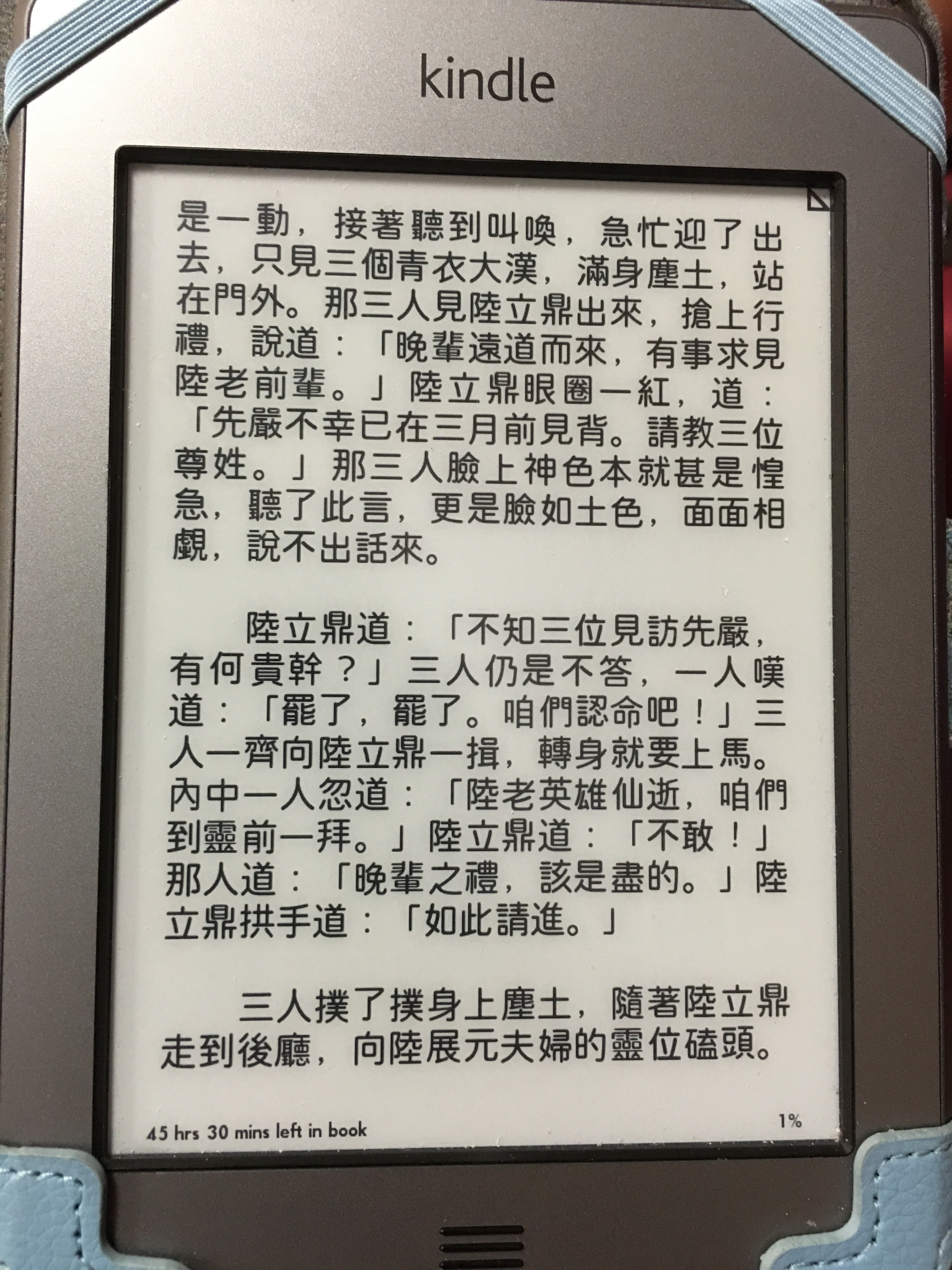
While waiting for our flight home after a fantastic vacation, I challenged 12 year old “Charlotte ” to read 金庸’s 神鵰俠侶 on the Kindle, the cartoon version of which she watched a few years ago. (Otherwise, she can do math! We have more than an hour to kill.) However, the first chapter is slow, as it is just the opening, to introduce the character of 李莫愁. In any case, besides a few questions every now and then, Charlotte seems to be able to read it. There are some cultural background information that I do have to explain to her, such as why some people are referred to as “晚輩“, “前輩”, “賢弟”, “英雄“. Of course, these terminologies are an integral part of the kung-fu literary world, and, along with other terminologies, expression, and customs, reflect aspects of the Chinese culture.
Here is the cartoon version for those interested: 神雕俠侶
We had 9 year old “Georgia” do social studies reading on our trip. Though it is only a third grade textbook, it is a tough reading for her since there are many new words that we don’t use in our daily conversation here. This is the second time she worked on it. The first time was only for about 10 minutes with with explanation of the reading included. The second time was on New Year’s Eve for about 30 minutes, yes, while on vacation… For me, it is more important to practice reading the passages well than to “cover the materials” and go through the whole textbook, as we don’t have a specific curriculum and timeline for our instructions.
It was truly a pleasant surprise, that 12 year old “Charlotte” can compose in Chinese relatively well (by typing) despite having NOT written any Chinese since around 9 years old, except for character practice mainly. It had been my strategy that extensive reading of Chinese textbooks and novels would greatly help her with composition, but to see the process in action and the whole thing coming to fruition was just a joy.
One parent noted that the story that Charlotte had composed in the last couple of days reads like a translated novel. Well, there is a good reason for that. She read quite a few Chinese edition of American novels, including The Selection series, Ender’s Game, Twilight series, and Starters. She also read aloud with the Chinese tutor a couple of the Chinese edition of Arsene Lupin’s novels, commonly known as 亞森羅蘋 in Taiwan.
I think reading aloud is quite helpful for language learners. There are many excellent youth novels with zhuyin from Taiwan, such as 亞森羅蘋 series. I don’t know if there are as many youth novels with simplified characters and pinyin from mainland China. Books like these serve well as bridge readers and for read alouds. Here is what亞森羅蘋’s novels look like:
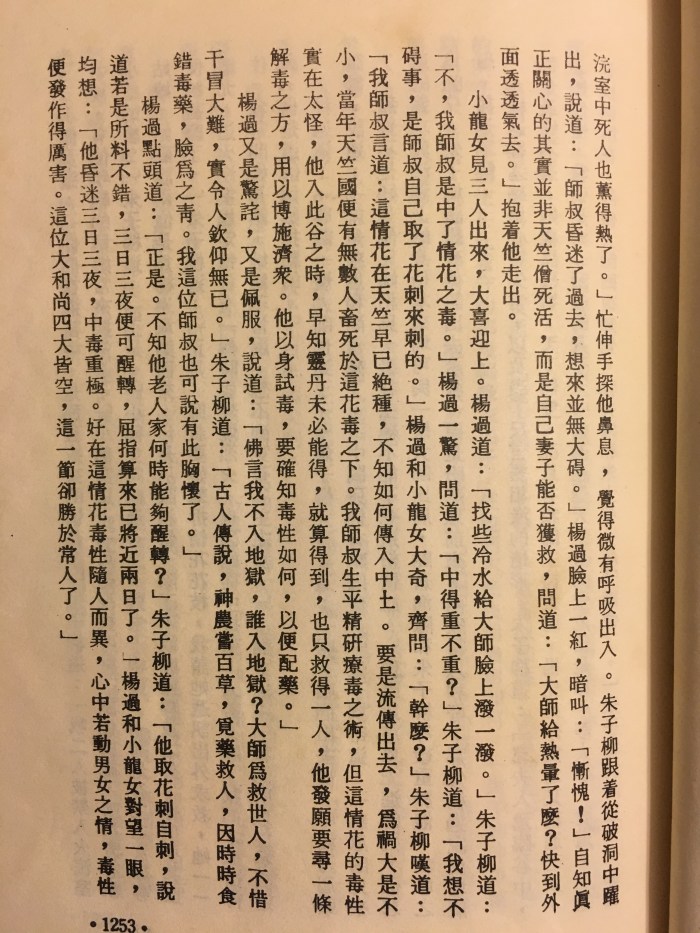
In any case, I think it is time that she reads some more original Chinese novels. She did read a couple of 倪匡‘s 衛斯理 series before. One of my goal is for them to be able to read 金庸’s kung-fu novels proficiently. I thought that it may still be a couple of years out. But, out of curiosity, I showed her a copy of 金庸‘s 神雕俠侶, whose story she is familiar through watching the cartoon version. She seems to get the gist of the story. Maybe I will have her read it aloud with the tutor’s assistance. Who knows, she may be ready for it!
A fellow parent’s child rearing experience points out an interesting concept on raising children to be trilingual in Chinese, Spanish (or other category 1 language), and English. This probably applies best to Chinese speaking household where English is not used much.
Have the child attend Spanish-English immersion school starting kindergarten or earlier. There is a good chance English will start to be introduced around 2-3rd grade. Spanish is easier to learn even compared to English, and the child can read chapter books fairly early in early elementary school.
Do lots of Chinese homeschooling with CLE (Chinese language ecosystem) at home as discussed before. Get reading level up quickly as described before.
Minimal or no English at home. Since the child has not formally learned English at school and does not get to speak English at home, he only gets a little of English exposure and won’t be as comfortable playing with and interacting with non-school individuals in English. The goal is for the child to prefer Chinese outside of school. At school, it is mainly Spanish.
When English is introduced and taught more and more at school, the child can learn English fairly readily, due to its similarity with Spanish and with all the English ecosystem outside of school and home. After a few years of learning, the child’s English may get close to that of monolingual kids.
The overall “scheme” is to for the child to learn an easier (but closely related to English) minority language at school and a difficult minority language at home. Then, add English, the community / majority language, at ~ third grade. Of course, time constraint will, as always, be the main factor in determining the proficiency of the various languages. There is still no getting around needing to cut back on other commitments if the child is to have equivalent proficiency in English and Chinese compared to other children (matched for age and intelligence) learning just English and Chinese but not Spanish. But, when the other children start putting time into learning Spanish (or other category 1 language such as French) in middle school or high school, things can even out, with better Spanish accent to boot.