I was organizing our digital photo album earlier today when I spotted a couple of videos of “Georgia” reading or speaking Chinese from ~ 3 years old to 8 years old. I put those videos together with the more recent ones, to give fellow parents some idea as to the pace that she was learning Chinese, which may be instructive to fellow parents. I hope this is helpful.
This is my sweet “Georgia” “reading” with our first au pair at 3 years old. How quickly a child grows up!
Here is Georgia reading a story book at ~ 5 years and 10 months old:
Here is she reading first grade textbook at ~5 years and 11 months old:
Here is she reading a story book at 7 years and 3 months old, at which time she already started reading comics without zhuyin: 這時侯她已開始看沒注音的漫畫。
Here is she reading second grade textbook at ~ 8 years and 2 months old:
Here is a reading of Bambi storybook at ~ 8 years and 3 months:
Here is Georgia reading third grade first semester textbook at ~9 years and 6 months old, at which time she can read the Chinese edition of Magic Tree House at about 800-1,000 characters a minute. About a month later, she read the Chinese edition of the first book of The Chronicle of Narnia without zhuyin.
This is Georgia reading third grade social study textbook this week at ~ 9 years and 8 months old:
Finally, here are some readings or recitation at ~ 9 years and 10 months old:
Many parents tried flash cards to teach Chinese reading. I certainly did for my elder daughter “Charlotte” when she was ~3-4 years old, now 12, but not for my younger one, “Georgia”, now 9. And many will continue to do so.
Regardless of the merit of flash card, I think there is a potentially interesting way to try flash card to “accelerate” Chinese reading for a few anxious parents, based on the work of Glenn Doman (1919-2013), founder of The Institutes of the Achievement of Human Potential outside of Philadelphia, and co-author of a series of “The Gentle Revolution” books, such as “How to Teach Your Child to Read”. The flash card part of the Doman method, as it is called, is based on using BIG flash card to teach infants and toddlers to read, do math/arithmetic, recite knowledge, etc. The institute also works to rehab “brain injured” children through pattern therapy, with criticism of effectiveness; but that’s a different story.
I had the pleasure of meeting Glenn Doman around 2003 in one of the courses the institute offers. Here is one of his videos:
In terms of the Doman flash card method, it is best to start at 0-24 months old, the earlier the better. Repetition and quickly (1 second or less) going over the cards are the name of the game. As with all things, preparation often takes longer than the “instruction” itself. Here is one non-offical website that points out the salient aspects of the method. To modify the program to Chinese, I think parents can start with radicals, then character, words, and finally sentence (sequence of cards).
Do I think it’s an overkill? Yes. Do I think it is necessary? Absolutely not. Do I think it can work for its intended purpose of accelerating character, phrase, and sentence recognition through pattern recognition? Yes. Do I think it can make a great reader out of your child? Yes, and no…. That will depend on the CLE, amount of reading practice, and the effort/priority you place from the time your child is ~ 4-12 years old.
I sure would like to see someone try. It will certainly make a very interesting and instructive blog (+ business opportunity?).
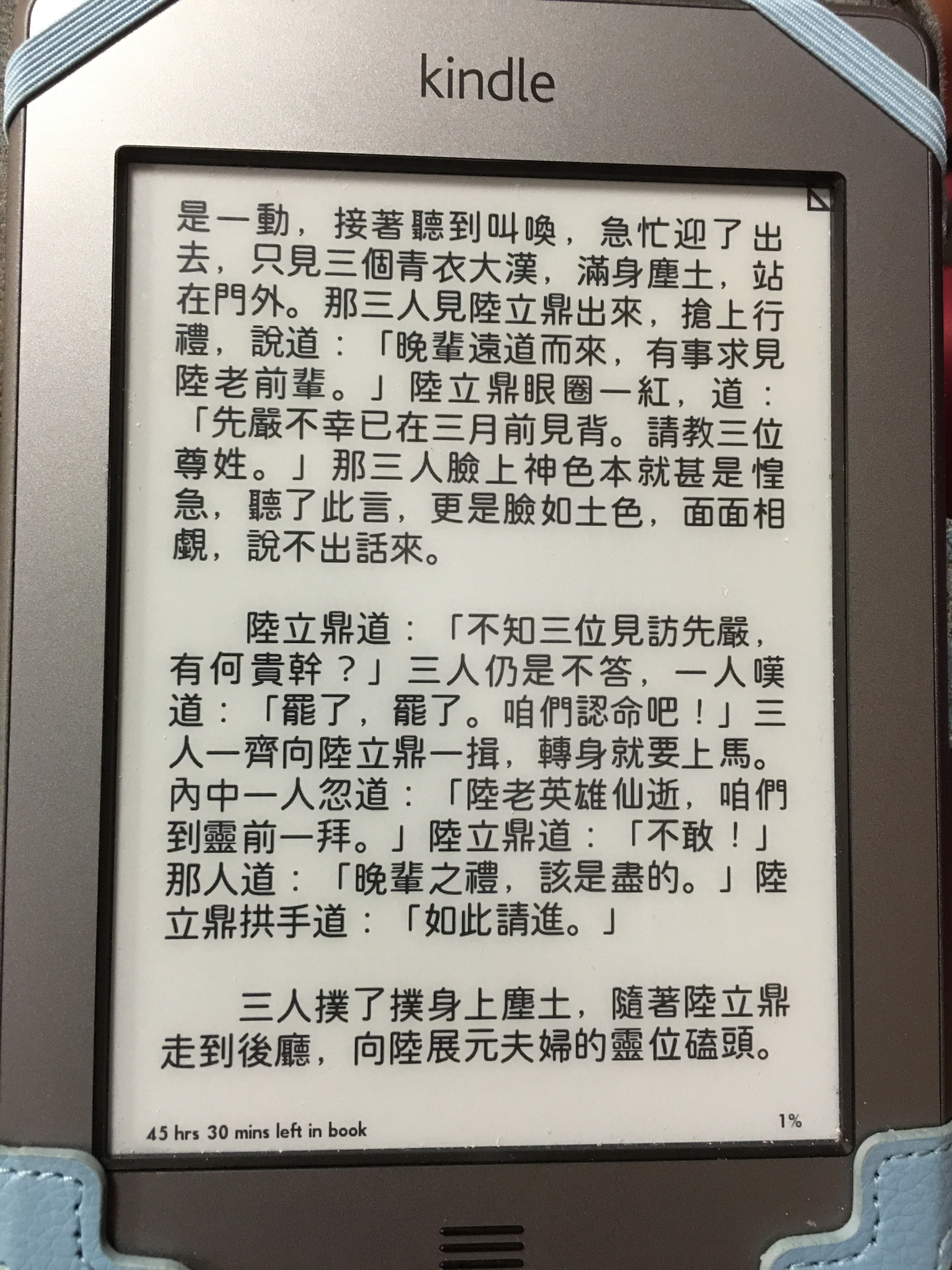
While waiting for our flight home after a fantastic vacation, I challenged 12 year old “Charlotte ” to read 金庸’s 神鵰俠侶 on the Kindle, the cartoon version of which she watched a few years ago. (Otherwise, she can do math! We have more than an hour to kill.) However, the first chapter is slow, as it is just the opening, to introduce the character of 李莫愁. In any case, besides a few questions every now and then, Charlotte seems to be able to read it. There are some cultural background information that I do have to explain to her, such as why some people are referred to as “晚輩“, “前輩”, “賢弟”, “英雄“. Of course, these terminologies are an integral part of the kung-fu literary world, and, along with other terminologies, expression, and customs, reflect aspects of the Chinese culture.
Here is the cartoon version for those interested: 神雕俠侶
We had 9 year old “Georgia” do social studies reading on our trip. Though it is only a third grade textbook, it is a tough reading for her since there are many new words that we don’t use in our daily conversation here. This is the second time she worked on it. The first time was only for about 10 minutes with with explanation of the reading included. The second time was on New Year’s Eve for about 30 minutes, yes, while on vacation… For me, it is more important to practice reading the passages well than to “cover the materials” and go through the whole textbook, as we don’t have a specific curriculum and timeline for our instructions.

 Raising bilingual and biliterate children in Chinese and English